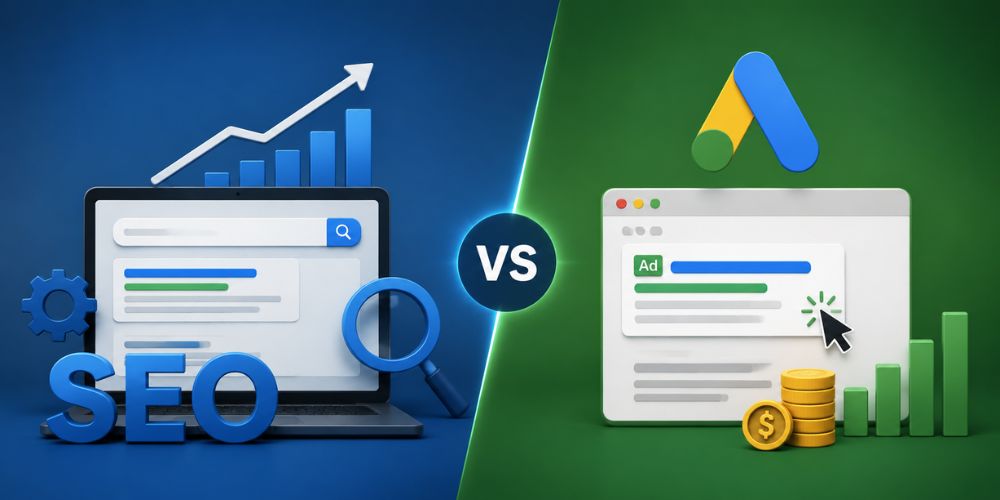
When it comes to growing a business online, understanding the difference between SEO and Google Ads or AdWords is one of the most important decisions within any digital marketing strategy. Both channels compete for the same real estate on the SERP, yet they serve fundamentally different purposes. Search engine optimisation builds organic rankings and organic traffic over time with compounding value, while pay-per-click and PPC campaigns through online advertising deliver paid traffic and immediate sales by placing your brand directly in front of prospective customers the moment they search. The numbers speak for themselves, as the average conversion rate for organic search sits at 2.4%, compared to 1.3% for ad-click users, yet neither channel wins outright.
What is SEO?
SEO, or Search Engine Optimisation, is the process of improving your website’s visibility in organic search results on platforms like Google, so that when people search for products or services related to your business, your site appears prominently without paying for every click. It works by strengthening three core pillars:
- Technical performance, which ensures your website runs fast and functions correctly.
- Relevant content, which aligns your pages with the keyword clusters and user search queries your audience is actually typing.
- Trust signals like inbound links, reviews, and domain authority that tell search engines your site is credible.
Unlike paid ads, SEO builds steady, sustainable traffic over months and years, and the payoff compounds the longer you invest, turning consistent content production, on-page optimisation, technical audits, and link acquisition into a long-term engine for brand awareness and organic leads.
What is Google Ads?
Google Ads is one of the most powerful paid advertising platforms available to businesses today. It helps businesses appear in Google search results and across Google’s wider partner network by using a pay-per-click model, where advertisers bid on keyword phrases and pay when users click on their ads.
Google Ads works by giving businesses control over three core areas:
- Campaign reach: Allowing businesses to advertise through search ads, display campaigns, YouTube placements, and app campaigns.
- Audience targeting: Helping advertisers reach the right people based on location, demographics, interests, behaviours, and search intent.
- Performance tracking: Using conversion tracking to measure real results such as ROI, cost per acquisition, landing page performance, and campaign effectiveness.
What makes Google Ads especially valuable is its speed. New launches, seasonal offers, and time-sensitive promotions can gain visibility almost instantly without waiting for organic growth. Campaigns can also be paused, edited, tested, or scaled at any time, giving businesses full control over their budget and ad spend.
However, unlike SEO, Google Ads only delivers traffic while the campaign is active and funded. Once the budget runs out or the campaign is switched off, the traffic stops immediately. This makes ongoing campaign management, smart budget allocation, and performance optimisation essential for keeping customer acquisition costs aligned with wider business goals.
What are the Different Roles of SEO and Google Ads?
SEO and Google Ads each play a distinct but deeply complementary role in a well-rounded search marketing strategy. SEO focuses on building long-term authority and visibility through organic rankings by improving website content, technical performance, site design, and user experience so that Google recognises the site as relevant and trustworthy. This includes content creation through videos and infographics, smart content optimisation, link building, and making sure smooth navigation that keeps users engaged throughout the funnel. Google Ads, on the other hand, drives immediate brand exposure through paid search, using pay-per-click and online display advertising with precise keyword targeting to appear at the top of the SERP regardless of organic position. Together, they cover the full spectrum of search queries and customer engagement at every stage of the funnel:
- SEO builds sustainable web presence and authority over time through content strategy, technical performance, and link building.
- Google Ads delivers instant visibility and performance by targeting high-intent search queries with paid placements.
- Combined, they maximise SERP coverage, reinforce brand exposure, and create a digital strategy where organic search and paid search continuously support each other’s results.
SEO vs Google Ads: Which Works Better?
SEO and Google Ads both drive traffic, but they serve very different purposes depending on where you are in your growth journey. Google Ads delivers immediate traffic the moment your campaign goes live, making it ideal for testing offers, validating messaging, and generating leads fast, especially when you need measurable, flexible results in a short-term window. SEO, on the other hand, builds organic authority over time, creating a steady pipeline of traffic that compounds without paying for every click, which dramatically lowers acquisition costs in the long run. The real question isn’t which one works better, it’s which one works better for your goal right now.
Here’s how each channel performs where it matters most:
- Google Ads for Immediate Results: You can appear on page one today, drive traffic overnight, and start collecting performance data within days.
- SEO for Long-term ROI: SEO wins. Once you earn rankings, traffic flows consistently without ongoing spend, and organic authority is an asset that grows over time.
- Google Ads for Lead generation on a budget: Google Ads gives you control and speed, but SEO reduces cost per acquisition significantly once it gains traction.
- Testing and flexibility: Google Ads lets you pivot your messaging, targeting, and offers almost instantly, making it a powerful tool for experimentation.
- Sustainable growth: SEO builds the foundation, turning your content strategy into a long-term traffic engine that doesn’t pause when the budget does.
The smartest digital marketing strategy uses both channels together. Ad performance data shows which keywords convert, which directly informs your SEO and content strategy. Strong organic rankings improve brand trust, which lifts click-through rates and Quality Scores on your paid campaigns, ultimately lowering costs across both. Rather than choosing between SEO and Google Ads, treat them as two complementary strengths working toward the same goal, more traffic, better leads, and stronger, more predictable growth.
Pros and Cons of Google Ads
Google Ads is one of the most powerful paid search platforms available today, giving businesses instant visibility in front of high-intent audiences through search and display advertising. By targeting the right keywords and crafting compelling ad copy, brands can drive qualified traffic almost immediately after a campaign goes live, making it especially effective for short-term promotions, product launches, and competitive markets where organic reach takes time to build. The platform’s granular audience targeting, including demographic targeting and placement controls, means your budget is directed toward the people most likely to convert. Layered on top of this is robust conversion tracking, which ties ad spend directly to real outcomes, allowing you to measure ROI with precision and make data-backed decisions on campaign management.
Pros
- Instant Results: Campaigns go live quickly, driving traffic and leads from day one rather than waiting for organic growth.
- Precise Audience Targeting: Reach specific demographics, locations, and placements with fine control over who sees your ads.
- Measurable ROI: Conversion tracking links every click and leads back to ad spend, making performance data transparent and actionable.
- Full Flexibility: Pause, adjust, or scale campaigns at any time, budget and strategy stay entirely in your hands.
- Excellent for Testing: A/B test ad copy, keywords, and landing pages to continuously improve click-through rate and conversions.
- Massive Reach: Access both search and display advertising across Google’s vast network, covering a huge share of online traffic.
Cons
- Costs Add up Fast: Competitive markets push keyword bids high, meaning significant ad spend is needed to maintain meaningful visibility.
- Ongoing Time Commitment: Effective campaign management demands regular monitoring, optimisation, and hours dedicated to performance reviews.
- Traffic stops When the Budget Does: Unlike organic SEO, pausing campaigns instantly removes your visibility, there is no residual reach.
- Steep Learning Curve: Getting the most from the ad platform requires deep knowledge of keywords, bidding strategies, and audience segmentation.
- Diminishing Returns Over Time: Without constant optimisation, performance can plateau and cost per lead rises as competition intensifies.
- Ad Fatigue and Blindness: Audiences exposed to the same ads repeatedly tend to tune them out, demanding fresh creative and ongoing testing.
Pros and Cons of SEO
SEO is one of the most powerful long-term channels available to any website. Done right, it builds organic visibility that compounds over time, driving consistent traffic without a recurring ad spend. But it comes with real trade-offs worth understanding before committing to it as a core strategy.
Pros
- Compounding Organic Growth: Quality content and strong domain authority build on themselves, rankings improve over time, not overnight.
- Reduced Dependence on Ad Spend: Once established, organic traffic flows without paying per click, freeing budget for other investments.
- Trust and Brand Credibility: High search rankings signal authority to users. Consistent visibility builds brand recognition and long-term trust.
- Better User Experience: On-page SEO and technical SEO improvements, faster load times, cleaner structure, benefit real users too.
- Stability at Maturity: A well-established site with strong keyword rankings and link building in place becomes resilient and self-sustaining.
Cons
- Results take months: SEO is not a quick win. Meaningful movement in search rankings often takes 3–6 months or longer to materialise.
- Algorithm dependency: Search engine algorithms update constantly. A single core update can shift rankings significantly, requiring rapid adaptation.
- Ongoing content and technical upkeep: Content strategy, content updates, and site performance maintenance are continuous, not a one-time effort.
- High initial investment: Building domain authority through quality content and link building demands significant time, skill, and often budget upfront.
- No guaranteed returns: Even with a solid content strategy and technical SEO in place, rankings are never fully guaranteed or permanent.
Do Google Ads Help With SEO?
Many business owners assume that running Google Ads will somehow boost their organic rankings, but that is not how search works. Google has confirmed repeatedly that paid spend through AdWords has zero direct influence on where your website appears in organic search results. The two systems operate on entirely separate tracks. What Google Ads genuinely does, however, is give your brand immediate Page 1 visibility while your SEO strategy builds momentum in the background. That dual presence on the SERP, both a paid ad and an organic listing, signals authority and credibility to the consumer, and research consistently shows that combined visibility drives higher click-through rates and stronger engagement than either channel delivers alone.
Here is why a combined strategy protects and grows your web presence:
- Paid search fills the gap while organic rankings are still climbing, keeping you visible in high-competition keyword territories from day one.
- SEO builds compounding growth that paid ads alone can never replicate, reducing cost dependency over the long run.
- Search query reports from ad campaigns reveal real audience language and intent, which directly informs stronger organic content.
- Dual SERP presence reinforces brand credibility and authority, increasing the likelihood a user clicks regardless of which listing they land on.
- Resilience across algorithm shifts means a zero-click search environment or ranking fluctuation hurts far less when you have both channels active.
For budget allocation, a proven digital strategy typically leans toward an SEO-weighted mix, directing roughly 60 to 70 percent toward organic growth and 30 to 40 percent toward paid search, scaling that ratio as organic rankings mature and begin to carry more of the traffic load.
When to Use Both
The smartest digital marketing strategies don’t choose between SEO and Google Ads, they use both together. Running paid search and organic search in parallel turns each channel into a feedback loop for the other. Google Ads delivers immediate performance data on converting keywords, messaging, and acquisition costs, while high-ranking SEO pages reveal which topics carry real search intent worth spending on.
Here’s when combining both makes the most sense:
- Competitive keywords are too slow to rank for organically, paid search fills the gap while SEO traction builds.
- SERP dominance increases when you hold both an ad position and an organic result simultaneously.
- Ad performance data sharpens your keyword and content strategy before you invest months in organic growth.
- Quality Scores improve when ads align with strong organic pages, lowering costs over time.
- Lead generation speed up while acquisition costs drop as both channels compound together.
When SEO insights make your ads smarter and ad insights sharpen your content strategy, you stop running two separate campaigns and start running one unified growth engine.
When Should You Invest in SEO?
SEO makes the most sense when you’re building for the long term. If you’re in a trust-dependent industry like B2B services, legal, or finance, organic rankings do more than drive traffic, they build brand credibility and signal authority before a prospect ever reaches out. Unlike paid channels that stop the moment you cut budget, a well-executed SEO campaign compounds over time, turning keyword clusters and website content into lasting SEO assets with a longer lifespan and a lower long-term cost of acquisition.
SEO is especially worth prioritising when:
- You rely on inbound leads and want a sustainable pipeline.
- Paid channels are becoming expensive or unpredictable.
- You’re in a high-trust industry where search rankings influence buyer decisions.
- You want compounding ROI rather than renting attention month to month.
The bottom line: SEO isn’t a quick fix, it’s a sustainable strategy and a marketing investment that grows in value the longer you commit to it.
When Should You Invest in Google Ads?
Google Ads makes the most sense when you need speed. Whether you’re launching a new product, running a seasonal push, or simply testing a new market, paid search gets you visibility within days rather than waiting months for organic rankings to build. It works especially well in competitive markets where immediate demand already exists and you need to show up right now, not eventually.
You should strongly consider Google Ads when:
- You have a clear budget and need results on a defined timeline.
- Your SEO is still in early stages and organic rankings are months away.
- You’re entering a competitive market where competitors are already running ad campaigns.
- You want to test conversion rates on a new offer before scaling.
- You need immediate demand capture, not awareness building.
The key is ROI clarity. Google Ads rewards intent, so if people are already searching for what you sell, ad spend converts far more efficiently than almost any other channel. Without that existing demand in the background, even the best campaign struggles to perform.
Work With an Agency That Has Mastered SEO and Google Ads
Most businesses pour money into SEO and Google Ads separately, with no strategy connecting the two. The result is wasted budget, conflicting data, and a growth ceiling you can’t seem to break through. The problem isn’t the channels, it’s running them in isolation. A unified search strategy uses paid data to sharpen your organic content and organic authority to lower your ad costs. When both channels work together, your cost per acquisition drops and your visibility compounds. That’s not theory, it’s exactly how sustainable search growth works in practice.
At Growth Metrics Ltd, we build integrated SEO and Google Ads strategies that turn search into your most reliable revenue channel. Our team brings together paid search specialists and SEO strategists who work as one unit, not two separate departments. The call is free, the insights are real, and the next step is yours. Book a free strategy call today and find out exactly where your budget is leaking, and how to fix it.
Conclusion
Comparing SEO and Google Ads is ultimately an apples-to-oranges conversation. They are not rivals competing for the same role in your strategy, they are complementary channels designed to solve different problems at different stages of growth. When managed together with integrated reporting and a unified digital strategy, they create a level of brand visibility and SERP dominance that neither channel can achieve independently.
When both channels run in sync, the benefits multiply. Paid search data informs organic strategy. Organic credibility improves paid conversion rates. Channel synergy reduces overall cost per acquisition while strengthening your position across the full SERP. For businesses serious about digital marketing performance, the real question is never SEO or Google Ads, it is how well you are running both.