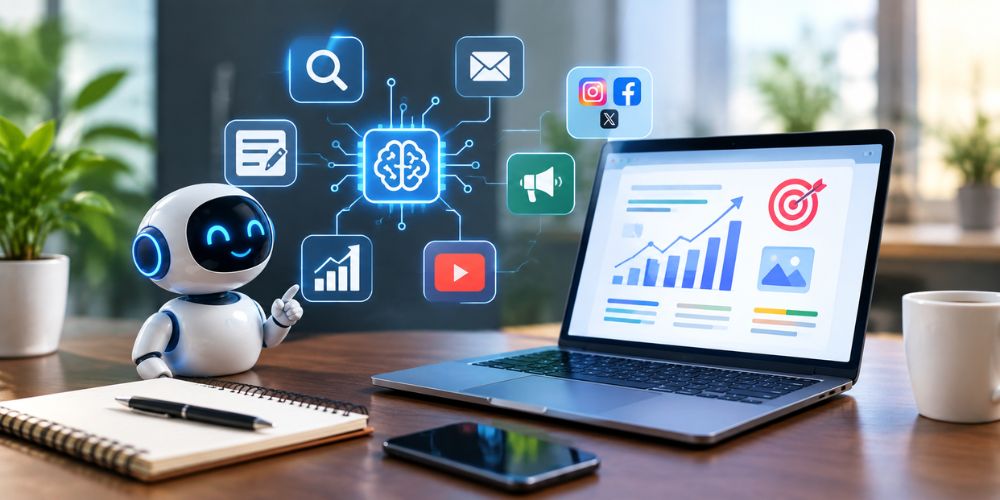
Artificial intelligence is changing the way businesses approach digital marketing. From creating content and analysing customer behaviour to improving advertising campaigns and answering customer questions, AI is becoming part of many everyday marketing tasks.
You may already be using AI without realising it. Product recommendations, personalised emails, chatbots, targeted adverts and search results can all use AI to understand what people are looking for and predict what they may do next.
But what does AI in digital marketing actually mean? How is it used, and does it replace the work of digital marketers? In this guide, we’ll explain what AI in digital marketing is, how it works, where businesses are using it, its main benefits and challenges, and how you can start using AI in your own marketing strategy.
What is AI in Digital Marketing?
AI in digital marketing means using artificial intelligence to help plan, create, manage and improve marketing activities.
AI systems can process large amounts of data, find patterns, make predictions and automate certain tasks. This helps marketers to spend less time on repetitive work and more time on strategy, creativity and customer needs.
For example, a business could use AI to:
- Find topics for new content
- Analyse customer behaviour
- Personalise website content
- Write a first draft of an email
- Suggest social media ideas
- Analyse advertising results
- Answer common customer questions
- Identify potential customers
- Predict which products a customer may be interested in
AI does not mean handing your entire marketing strategy over to a machine. It is better viewed as a tool that helps marketers work with information and complete certain tasks faster.
How Does AI Work in Digital Marketing?
AI uses data and algorithms to identify patterns and make predictions or generate content. For example, an online shop may have data about the products customers view, the products they buy and how they interact with the website. AI can analyse this information and identify patterns in customer behaviour. A business can then use those insights to show more relevant products, send personalised emails or improve its advertising. There are several types of AI that are useful in digital marketing.
Generative AI
Generative AI creates new content based on the instructions and information it receives. Marketers can use tools such as ChatGPT to generate blog ideas, draft content, write emails and social media posts, create ad copy and images, summarise information and produce different content variations. These tools can support content creation and research tasks, but their output should still be reviewed for accuracy and quality.
Automation
AI can also automate repetitive marketing tasks. This can include sending follow-up emails, organising customer information, analysing campaign data and responding to common questions. The goal is not simply to automate everything. The useful part is removing repetitive work where automation can save time without reducing the quality of the customer experience.
AI Agents
AI agents are a newer development in marketing. Instead of only responding to a prompt, an AI agent can be given a task and work through several steps to complete it. For example, an AI agent could help research customer information, identify an opportunity and prepare a recommendation for a marketer to review.
How is AI Used in Digital Marketing?
AI can be used across almost every major part of digital marketing. Here are some of the most common examples.
1. AI for Content Marketing
Content marketing is one of the most common parts where businesses use AI. AI can help marketers come up with ideas, organise research, create outlines, write first drafts and adapt existing content for different channels.
For example, a marketer could use AI to turn a long blog post into:
- A LinkedIn post
- Several social media captions
- An email
- A short video script
- A list of key points
This can save time when repurposing existing content. However, AI-generated content still needs human review. Marketers need to check facts, add useful experience and make sure the content actually helps the target audience. The strongest approach is to use AI to support content creation rather than publishing everything it produces without checking it.
2. AI for SEO
AI is also becoming part of SEO. Marketers can use AI to support:
- Keyword research
- Search intent analysis
- Topic research
- Content planning
- Competitor research
- Content optimisation
- Internal linking
- Content gap analysis
AI can help process large amounts of information quickly, but it does not remove the need for SEO knowledge. A marketer still needs to understand the business, its customers, search intent and what makes the website different from its competitors.
AI is also changing the way people search. As AI search tools and AI-generated answers become more common, businesses need to think about how their content can be found and understood across both traditional search engines and AI platforms. This is where areas such as answer engine optimisation (AEO) and generative engine optimisation (GEO) are becoming more relevant.
3. AI for Social Media Marketing
Social media teams can use AI to speed up many everyday tasks.
AI can help with:
- Post ideas
- Caption writing
- Content planning
- Audience research
- Social listening
- Performance analysis
- Content variations
- Basic customer responses
For example, a business could give an AI tool information about a new product and ask it to create several social media post ideas for different audiences. The marketer can then choose the strongest ideas, edit them and make sure they match the brand’s voice. AI can also help analyse which types of posts receive the most engagement and identify patterns in audience behaviour.
4. AI for Email Marketing
Email marketing can benefit from AI because businesses often have large amounts of customer and engagement data.
AI can help marketers:
- Write subject lines
- Create email drafts
- Group customers into different audiences
- Personalise messages
- Suggest when emails should be sent
- Analyse email performance
- Create different versions of campaigns
Instead of sending exactly the same email to everyone, businesses can use customer data to make messages more relevant. For example, an online retailer could send different product recommendations based on what customers have previously viewed or purchased.
5. AI for Paid Advertising
AI is widely used in online advertising. Advertising platforms can use AI to analyse user behaviour, identify audiences and help decide where advertising budgets should be placed.
Marketers can also use AI to:
- Create ad copy
- Generate creative ideas
- Test different messages
- Identify better-performing audiences
- Analyse campaign results
- Find patterns in advertising data
This can make campaign management faster, especially when a business is running many ads at the same time. However, marketers still need to set clear goals and monitor results. AI can help optimise a campaign, but it cannot decide what makes an offer valuable to a customer.
6. AI for Customer Service
AI-powered chatbots can help businesses answer common customer questions.
For example, a customer might ask:
- What are your opening hours?
- Where is my order?
- What services do you offer?
- How much does delivery cost?
- How can I book an appointment?
An AI chatbot can answer simple questions without requiring a member of staff to respond every time. This can make customer support faster, especially outside normal business hours. However, more complicated problems may still need a human. A good customer service system should make it easy for customers to reach a person when the question requires human judgement.
7. AI for Marketing Analytics
Digital marketing creates a huge amount of data. Businesses can track website visits, clicks, conversions, advertising costs, customer behaviour and many other metrics. AI can help marketers analyse this information and identify patterns more quickly.
For example, AI could help identify:
- Which campaigns are performing well
- Which customers are more likely to convert
- Where a campaign is losing potential customers
- Unusual changes in performance
- Which channels are producing the best results
This can help marketers make decisions based on data rather than relying only on assumptions.
What are the Benefits of AI in Digital Marketing?
AI can offer several benefits when it is used correctly.
Saves Time
AI can handle many repetitive tasks that would otherwise take marketers hours to complete. This gives marketing teams more time to focus on planning, creativity and strategy.
Helps Analyse More Data
Businesses collect large amounts of marketing data. AI can process this information much faster than a person working manually. This can help marketers find patterns and useful insights.
Improves Personalisation
AI can help businesses understand customer behaviour and create more relevant experiences.
Supports Better Decisions
AI can identify patterns and provide insights that can help marketers make better decisions about campaigns, audiences and content.
Helps Scale Marketing
A small marketing team can use AI to support more tasks without having to manually complete every part of the process.
Supports Faster Campaigns
AI can help with research, content creation, testing and reporting, help businesses to move from an idea to a campaign more quickly.
What are the Challenges of Using AI in Digital Marketing?
AI also has some risks and limitations. Businesses should understand them before using AI across their marketing.
Inaccurate Information
AI can generate incorrect information. This is why AI-generated content should always be reviewed before it is published or used to make important decisions.
Privacy Concerns
AI systems often rely on data. Businesses need to be careful about how they collect, store and use customer information. Customer data should be handled responsibly and according to relevant privacy requirements.
Poor-Quality Content
AI can produce content quickly, but more content does not always mean better content. If businesses publish generic or repetitive AI content without adding real value, their marketing can become less useful.
Lack of Human Judgement
AI can identify patterns and generate ideas, but it does not fully understand a business, its customers or its brand in the same way a human team does. Human judgement is still important for strategy, creativity and important decisions.
Over-Reliance on AI
Using AI for everything can create problems. Businesses should identify where AI genuinely helps instead of adding AI to tasks simply because the technology is available.
AI vs Traditional Digital Marketing
AI does not completely replace traditional digital marketing. Instead, it changes how many tasks are carried out.
| Area | Traditional Approach | AI-Powered Approach |
| Content | Mostly created manually | AI can help with research, ideas and first drafts |
| Data analysis | Manual reports and analysis | AI can identify patterns and trends |
| Personalisation | Basic audience groups | More detailed, behaviour-based personalisation |
| Email marketing | Pre-set campaigns | AI can support segmentation and timing |
| Advertising | Manual testing and optimisation | AI can help with targeting and campaign optimisation |
| Customer service | Mainly human support | AI can handle common questions with human support when needed |
| SEO | Manual research and analysis | AI can support research, planning and optimisation |
The important point is that AI and traditional marketing do not have to compete with each other. A strong marketing strategy can use AI where it saves time or provides useful insights while keeping humans responsible for the important decisions.
Best Practices for Using AI in Digital Marketing
The best results often come from using AI alongside human knowledge and a clear marketing strategy.
Here are some practical tips:
- Use AI to support your team rather than replace it.
- Give AI clear instructions and useful information.
- Always check important facts.
- Protect customer and business data.
- Keep your brand voice consistent.
- Add your own experience and expertise to AI-generated content.
- Test AI-supported campaigns before launching them.
- Track the results instead of assuming AI is working.
- Keep reviewing how your customers respond.
- Use AI where it solves a real marketing problem.
Will AI Replace Digital Marketers?
No. AI is more likely to change the role of digital marketers than remove it completely. AI can already help with repetitive tasks, data analysis, content drafts, campaign testing and customer responses. But businesses still need people to decide what they want to achieve, who they want to reach and how they should communicate with their audience. Human marketers also bring creativity, experience, brand knowledge and judgement.
What is the Future of AI in Digital Marketing?
AI will likely become a more common part of everyday marketing. We can expect to see more use of:
- Personalised customer experiences
- Predictive analytics
- Automated marketing workflows
- AI-powered ads
- AI search and recommendations
- AI content creation
- Customer service automation
- AI agents that complete multi-step tasks
- Data-driven marketing decisions
AI agents are already becoming an important area of development because they can do more than generate a response. They can work through a task using approved information and instructions. At the same time, businesses will need to pay more attention to privacy, data quality, accuracy and responsible AI use. The future of digital marketing is unlikely to be completely human or completely automated. It will be a combination of both.
Why Human Expertise Still Matters
AI can process information quickly, but speed does not automatically mean quality. A good marketer understands the customer, the business and the market. They understand which messages are more likely to connect with their audience and which claims should be avoided.
Human review is important because AI can make mistakes or provide information that sounds right but is incorrect. The strongest digital marketing strategies combine the speed and data-processing ability of AI with human experience, creativity and judgement.
Ready to Grow Your Business with AI-Powered Marketing?
AI can help your business save time, understand customer behaviour, create useful content and improve marketing campaigns. However, the best results come from using AI as part of a clear strategy, with human expertise guiding important decisions.
At our digital marketing agency, we help businesses apply AI across every part of their digital strategy. Our SEO services and ecommerce SEO help your website and products appear in traditional and AI-powered search. Our AI SEO services improve how search platforms understand your brand, while AI-supported content marketing helps you create useful, relevant content. We also use data to improve PPC advertising, develop user-friendly websites and support more effective digital campaigns. Contact our team to discuss how these services can help your business grow.
Conclusion
AI is changing digital marketing by helping businesses work with data, automate repetitive tasks, create content, personalise customer experiences and improve campaigns. But AI is not a replacement for a good marketing strategy.
Businesses still need to understand their customers, create useful content, build trust and make good decisions. AI can help with many of the tasks around those goals, but human expertise remains important.
The best approach is to start small, choose tasks where AI can provide real value and measure the results. As AI continues to become part of SEO, content, advertising, social media, email and customer service, businesses that learn how to use it properly can make their marketing faster, more useful and easier to scale.