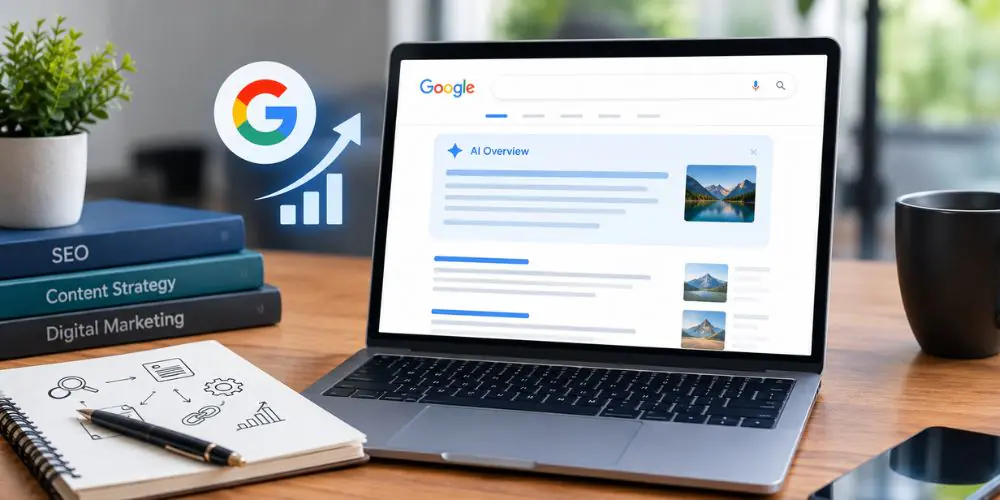
Google Search is changing how people find information and discover businesses. AI Overviews now appear above traditional results for some searches, giving users a summary and links to supporting websites. This means potential customers can find answers before reaching your organic listing.
A Semrush study of more than 10 million keywords found that AI Overviews appeared for around 16% of the keywords tracked in November 2025, following a peak of nearly 25% in July. These figures show how widely their presence can change within a few months.
For businesses, this creates another consideration, a page-one ranking does not necessarily mean your website captures the reader’s attention. Earning a citation within an AI Overview offers another opportunity to be discovered while potential customers research questions relevant to your business.
So, how can your website become one of those sources? This guide explains how Google AI Overviews work, how they differ from featured snippets and the practical steps you can take to improve your chances of appearing.
What is a Google AI Overview?
A Google AI Overview is an AI-generated answers that appears above the organic results . It brings together information to answer a question and includes links that people can use to explore the topic further. Google introduced the feature to help users understand subjects without piecing together every detail themselves.
For example, someone researching how to choose a digital marketing agency might want to understand services, pricing and reporting. An overview could help explain those considerations and point them towards supporting resources.
How AI Overviews Differ from Featured Snippets
Both features help people find answers within search results, but they present information differently.
Feature
Featured snippet
AI Overview
Answer format
An excerpt selected from a web page
An AI-generated explanation
Sources
Typically highlights one page
Can reference several supporting pages
Presentation
Often a paragraph, list or table
A summary that may cover several aspects of a question
Website opportunity
Your content appears as the selected excerpt
Your page appears as a supporting source
Google selects featured snippets automatically. AI Overviews use generative AI to produce their explanations and provide supporting links. Appearing in a featured snippet does not guarantee that your page will also be cited in an AI Overview.
When Did AI Overviews First Appear?
AI Overviews developed from Google’s earlier experiments with generative search:
May 2023: Google introduced its experimental Search Generative Experience through Search Labs. Google’s announcement.
May 2024: AI Overviews began rolling out publicly in the United States.
October 2024: Google announced expansion to more than 100 countries and territories.
AI Overviews have changed since their early testing phase, so older advice may no longer apply.
How AI Overviews Affect Search Visibility
The business question is how these answers affect discovery, website visits and enquiries. In a study of US browsing activity from March 2025, Pew Research Center found that people clicked a traditional search result in 8% of visits with an AI summary, compared with 15% without one. This was an observed pattern, not proof that AI Overviews caused every difference or a forecast for individual websites.
Alongside rankings, track how often people see your content, click through to your website and contact your business or make a purchase.
Being cited in an AI Overview can help potential customers discover your business. Give them a reason to explore your website with useful comparisons, practical guides or services that meet their needs.
Which Searches Trigger AI Overviews?
AI Overviews do not appear for every search. Google says they appear when its systems judge that a generated response adds value to the search experience.
To investigate opportunities for your business, start with questions that need explanation, comparison or several considerations. For a digital marketing agency, examples to check could include:
What is the difference between SEO and PPC?
How do I choose an SEO agency for a small business?
Why has my website’s organic traffic dropped?
What should an SEO audit include?
How should a business measure SEO results?
These are research examples, not guaranteed triggers. Check the searches your customers actually make and record what appears. A keyword list alone will not tell you which results currently include an overview.
How Google Chooses Pages to Cite
Google does not publish a formula that guarantees a citation. To qualify as a supporting link, a page must be indexed and eligible to display a search snippet. Meeting these requirements does not guarantee that your page will appear in an AI Overview.
Google’s AI features can also run related searches across subtopics, a process it calls query fan-out. That helps explain why supporting sources may address different parts of a broader question.
Plan your content around what readers need to know. For example, a guide to choosing an agency could explain how to review proposals, compare reports and check the agency’s experience. Each section should offer clear, practical information that helps readers make a decision.
Steps to Rank in Google AI Overviews
1. Start with a Clear Answer
AI Overviews help users find answers quickly, so your content should do the same. Get straight to the point in the first few lines, then add supporting details, exceptions and next steps. For example, under “What should an SEO audit include?”, explain that it should check search engine access, whether pages meet customer needs and issues affecting performance. It should also recommend which improvements to make first.
Then explain each area with practical examples. Match the answer’s length and format to the question. A definition may need two sentences, while a comparison may work better in a table. Keep the answer easy to find without leaving out important details.
2. Write Content with a Clear Purpose
Quality matters more than how often you publish. Use keyword research and customer questions to understand what your audience needs, then decide what each page should help readers learn or do. For example, a guide explaining why service pages receive few enquiries has a clearer purpose than a broad article on “SEO tips for businesses”. It can help readers review their content, messaging, navigation and enquiry forms.
Add useful insights from your own work, such as practical examples, checklists or answers to common customer questions. Google’s advice for AI search encourages valuable, original content. Give readers a reason to choose your page by offering useful details they cannot find in every other article on the topic.
3. Build Trust Through Consistent Content
Publish useful, accurate content that customers can trust. Accuracy is especially important in areas such as legal, healthcare and financial services, where advice can affect important decisions. Focus on topics your business understands. For example, a digital marketing agency might cover SEO audits, local visibility, website content and reporting. Each article should answer a specific customer question and link to related pages where helpful.
Review older articles when your services, processes or information change. Keep details consistent across your website so readers do not find conflicting advice. Choose a publishing schedule that gives you time to maintain quality and keep existing content up to date.
4. Show Experience and Expertise That Google Can Trust (E-E-A-T)
Help readers trust your website by showing who created the content and what experience supports the advice. Include relevant author details, clear business information and examples from your work. E-E-A-T stands for experience, expertise, authoritativeness and trustworthiness. Google uses these concepts in its quality guidance, but they do not form a single ranking factor or score.
Use helpful examples, relevant data and reliable sources to support your content. Expert insights can also help readers trust what you share. For example, an article about website audits could include a screenshot highlighting a problem and explain how it was assessed. When discussing a test or project, describe your method and any limitations, and only share results you can support with evidence.
5. Keep Your Content Clear and Easy to Read
Make your page easy to scan and understand. Use short paragraphs, clear headings and simple language. Give each section a clear purpose, and explain technical terms when needed. Use numbered steps for processes, tables for comparisons and bullet points for checklists. Use paragraphs when readers need more explanation or context.
For example, a table makes monthly SEO reporting options easier to compare than a long paragraph. Check your page on a phone too. Make sure the text is readable, tables fit the screen and pop-ups do not block the content. Google includes a good page experience in its advice for AI search. Google’s AI search guidance.
6. Use Technical SEO to Help AI Understand Your Website
Technical problems can prevent Google from finding and indexing useful content. Keep your website fast, secure and easy to navigate, and make sure Googlebot can access your pages. Use Search Console to check important pages for indexing restrictions, loading errors and access problems. Key information should be available as text on pages that do not require visitors to sign in.
Also check the Search generative AI setting in Search Console to make sure your website has not been excluded from AI Overviews. If the setting comes from a parent property, review that setting too. Resolve access and indexing issues first so your content can be considered for inclusion.
7. Plan Your Content Around User Intent
Build your content around what people want to learn or do when they search. This is called user intent. Someone searching “What is technical SEO?” needs a simple explanation, while someone searching “SEO agency vs in-house team” wants to compare options. A question about SEO pricing needs clear cost information, while a search for an ecommerce SEO agency calls for service details and evidence of relevant experience.
Use customer conversations, sales questions and search data to understand these needs. Then choose the content format that answers them best, such as a guide, comparison or service page. Include related questions when they help readers with the same task. If a question needs a different or more detailed explanation, cover it on a separate page and link to it where useful.
8. Write for People First, Then Consider AI
Write content that helps people understand a problem, compare their options and decide what to do next. Answer questions clearly, use familiar examples and explain things in plain English. For example, an agency comparison could suggest questions to ask during a proposal call and explain how to assess the answers. These details give readers practical help when choosing a provider.
AI tools can help organise ideas or prepare a draft, but someone with relevant knowledge should check the facts and recommendations. Remove wording that adds length without adding value, and avoid publishing large numbers of repetitive pages. Google’s spam policies address content produced at scale mainly to manipulate rankings, whether it is written by people or AI.
9. Set Up Your Schema Markup Correctly
Schema markup helps search engines understand the information on your page. Choose a type that matches your content, such as Article for a blog post, Product for a product page or LocalBusiness for business details. Make sure the information in your markup matches what visitors can see on the page.
Check your existing markup before adding a new plugin or template to avoid conflicting details. Keep it accurate as your content changes. Schema can support your wider SEO strategy, but Google does not require special markup for AI Overviews, and adding it does not guarantee a citation.
10. Earn Brand Mentions on Other Websites
Share useful knowledge beyond your own website through expert comments, original research or industry discussions. For example, an agency could explain common website problems and share its findings with a publication read by business owners. Focus on providing information that helps the publication’s audience.
Mentions on relevant websites can help people discover your business, but they do not guarantee a citation in an AI Overview. Avoid buying links to influence rankings or publishing low-quality articles just to gain backlinks.
11. Optimise Visuals for AI Indexing
Use screenshots, original photos or simple diagrams to make your content easier to understand. Give each image a descriptive filename and clear alt text, and place it beside relevant information. Reduce file sizes without losing clarity, and check that images display properly on mobile devices.
Add images using standard HTML image elements so Google can find them, rather than relying on CSS backgrounds. Keep important explanations in the page text too. For example, explain what an audit screenshot shows and why it matters. These steps improve accessibility and help Google discover your images, but they do not guarantee inclusion in an AI Overview.
Where Do AI Overviews Get Their Information?
AI Overviews use information from different types of websites. A Pew Research Center study of searches from March 2025 found links to Wikipedia, YouTube, Reddit and other sources. These findings show which sites appeared in that sample, rather than a fixed list Google always uses.
Review the pages cited in AI Overviews for searches related to your business. Notice whether they offer clear explanations, practical experience, comparisons or supporting evidence. Use this research to find questions your content could answer more helpfully. Copying a cited page’s headings or layout does not guarantee the same result.
How to Track and Measure Your AI Overview Visibility
Use reporting data alongside checks of relevant searches. Together, they provide a more useful picture than a single screenshot or ranking position.
Review Search Console’s generative AI reports: Google introduced dedicated reports in June 2026 and announced worldwide availability by 31 August 2026. The Search report covers impressions within generative AI features, including AI Overviews and AI Mode, with views by page, country, device and date. Use these impressions to assess visibility, rather than treating them as visits or sales.
Check a consistent set of customer questions: Record whether an AI Overview appears, whether it links to your website and which page it cites. Note the date, country and device so your comparisons have context. Distinguish a linked citation from a mention of your business name.
Review business outcomes: Use your broader search reporting and website analytics to assess organic visits, enquiries and conversions. An increase in organic traffic alone does not prove that AI Overviews caused it.
Keep a record of changes: Note when you improve a page, fix an access issue or add supporting evidence. Compare performance over time and look for repeated patterns before deciding what to do next.
Start with a small set of commercially relevant pages. That makes it easier to connect your observations with practical improvements.
Ready to Improve Your Visibility with AI-Optimised SEO?
Preparing for AI search starts with understanding where your website needs improvement. That might mean clearer answers, stronger supporting content or technical issues that prevent important pages from being discovered.
Growth Metrics Ltd provides SEO services to help improve your website’s content, technical performance and search visibility. Our AI SEO services can help you develop an approach to AEO and GEO that supports your wider SEO strategy.
Get in touch to discuss how your website can better answer customer questions and support your business goals as search changes.
Conclusion
Improving your chances of appearing in Google AI Overviews requires useful content, a technically accessible website and a clear understanding of what customers need.
Start with your most important pages. Answer their main questions directly, add evidence and practical examples, and resolve any access or eligibility problems. Then track visibility alongside enquiries and other meaningful outcomes.
Use these steps as an ongoing improvement process. The aim is to build resources that deserve attention and give potential customers a reason to choose your business.
The way people search is changing. AI-generated answers now appear above many traditional search listings, giving users information before they visit a website. This means customers can discover brands, compare services and explore products directly within search results. For businesses, being visible also means being included in these answers.
Answer engine optimisation (AEO) and generative engine optimisation (GEO) are two approaches that can help brands improve their presence in Google AI Overviews and platforms such as ChatGPT and Perplexity. While these strategies overlap, they have different priorities. Understanding how they work alongside SEO can help businesses reach potential customers and strengthen their search presence.
What is AEO?
AEO stands for Answer Engine Optimisation. It is the process of creating and structuring content so that search engines and answer-focused platforms can understand it and use it to answer users’ questions.
Traditional SEO often focuses on helping a webpage rank in search results. AEO puts more focus on providing a clear answer to a specific question Instead of looking through several websites, they may see a direct answer in Google’s search results or another answer-based search feature. AEO aims to make your content useful for these types of searches.
How Does AEO Work?
AEO starts with understanding the questions your audience is asking. You can then create content that answers those questions clearly and directly. This can include:
Frequently asked questions
How-to guides
Short definitions
Step-by-step instructions
Comparison content
Lists
Tables
Clear explanations
You could provide a short answer near the top of the page, followed by a more detailed explanation, examples and related questions. This makes the content easier for both users and search systems to understand.
Benefits of AEO
AEO can help businesses:
Answer customer questions directly
Improve visibility for question-based searches
Increase opportunities to appear in search features
Make content easier to understand
Support traditional SEO
Reach people earlier in the buying journey
AEO is particularly useful for businesses that create educational content or answer common customer questions.
What is GEO?
GEO stands for Generative Engine Optimisation. GEO focuses on improving a brand’s visibility in AI-generated answers. Instead of only trying to rank a webpage in a traditional search result, GEO considers how AI systems understand and reference information about a business, product, service or topic.
The AI system may provide a list of companies or explain what businesses should look for when choosing an SEO agency. GEO focuses on helping your brand become more visible and understandable in these types of AI-generated responses.
How Does GEO Work?
AI systems use information from multiple sources to understand topics and answer questions. Businesses therefore need to look beyond individual keywords and create content that answers their customers’ questions.
Important areas can include:
Useful and original content
Expertise and experience
Brand mentions
Credible websites
Relevant links
Consistent business information
Clear explanations
Strong topical coverage
The goal is to build a website and brand that AI systems can understand and trust as a useful source of information.
Benefits of GEO
A strong GEO strategy can help businesses:
Increase visibility in AI-generated answers
Improve brand recognition
Build authority around important topics
Reach people using AI search tools
Support discovery during research and comparison
Improve their overall search strategy
GEO is still evolving, and AI platforms can change how they choose and display information. Businesses should keep their approach flexible rather than follow a fixed set of ranking rules.
AEO vs GEO: What is the Difference?
AEO and GEO are closely related, but their main focus is different.
Factor
AEO
GEO
Main focus
Direct answers
AI-generated answers
Main goal
Help content appear as an answer
Improve brand and content visibility in AI responses
Content approach
Clear, direct answers
Useful, detailed and authoritative content
Common opportunities
Featured snippets, question-based searches and AI search features
ChatGPT, Gemini, Perplexity and other AI tools
Key focus
Questions and content structure
Authority, relevance and brand signals
Relationship with SEO
Builds on traditional SEO
Builds on SEO, content and brand authority
AEO focuses on making your content easy to use as a direct answer to a question. GEO focuses on helping your brand and content appear in AI-generated responses.
The two approaches overlap. A page with clear answers, useful information, a logical structure and reliable sources can support both AEO and GEO.
Does AEO or GEO Replace SEO?
No. SEO remains the foundation for both AEO and GEO. Your website still needs to work well, be accessible to search engines and provide useful content. Clear navigation and pages that answer users’ questions remain essential.
Traditional SEO can support:
Crawling and indexing
Keyword targeting
Search visibility
Internal linking
Website structure
Page speed
Content quality
Authority and links
AEO and GEO build on these foundations rather than replacing them. Think of it this way, SEO helps your website become visible and understandable. AEO helps your content provide clear answers. GEO helps your brand and content become more useful and visible in AI-generated responses. A strong strategy can use all three.
How Do AEO and GEO Work Together?
AEO and GEO can work together within your overall SEO strategy. For example, if you run a digital marketing agency, you can use both approaches when creating content about SEO. You could start by researching questions your audience is asking. You then create a page that gives a clear answer to each question. This supports AEO. Next, you add detailed explanations, examples, original insights and supporting information. This gives the content more depth and can support GEO. You can then build related content around the wider SEO topic and link those pages together.
The result is content that is useful for:
Traditional search
Question-based searches
AI-generated answers
People researching a service
People comparing different options
This is why businesses should not focus only on one type of search. People now use different platforms to find information, and your content needs to be useful wherever your audience is searching.
How to Optimise Your Website for AEO and GEO
There is no guaranteed way to appear in answer engines or AI-generated responses. Focus on helpful content and a clear website structure. Here are some practical steps to get started.
1. Answer Your Audience’s Questions
Start by finding the questions your customers actually ask. These could come from:
Google searches
Customer emails
Sales calls
Support conversations
Social media
Online forums
Keyword research
Questions people ask your team
Give readers a clear answer first, then add more detail. Make the answer easy to find so they don’t have to read through several paragraphs.
2. Create Useful and Original Content
AI tools can create content quickly, but quantity alone does not make it useful. Focus on giving readers helpful information. This could include:
Original research
Examples
Practical advice
Expert opinions
Case studies
First-hand experience
Data
Helpful comparisons
Avoid simply rewriting what other websites have already published. If your content gives readers a reason to choose your page over another result, it is more likely to provide real value.
3. Build Topical Authority
Don’t create one page about a topic and stop there. Build useful content around the wider subject. For example, an SEO agency could create content covering:
What is SEO?
How does SEO work?
Technical SEO
On-page SEO
Link building
Local SEO
SEO audits
SEO reporting
SEO costs
How long SEO takes
These pages can link to each other where relevant. This helps users find more information and gives search systems a clearer understanding of the topics your website covers.
4. Show Your Experience and Expertise
People want useful information from sources they can trust. Show what your business knows and does. You can do this through:
Author information
Case studies
Real examples
Original research
Client results
Expert commentary
Industry experience
Clear information about your business
Don’t make claims that you cannot support. If you say your service delivers a particular result, explain how you achieved it or provide evidence where possible.
5. Make Your Content Easy to Understand
Good structure helps both people and search systems understand your content. Use:
Clear headings
Short paragraphs
Bullet points
Tables
Step-by-step instructions
Definitions
FAQs
For example, make the answer easy to find instead of hiding it in a long paragraph.
6. Build Your Brand’s Online Presence
GEO is not only about what is written on your website. AI systems can use information from different sources when building an understanding of a brand or topic. This makes your wider online presence important. Keep your business information consistent across relevant websites and profiles. This can include:
Business name
Website
Services
Company information
Contact details
Industry information
Relevant mentions from credible third-party websites can also help strengthen your wider online presence.
7. Use Structured Data Where It Makes Sense
Structured data helps search engines understand certain information on a webpage. Depending on your page, you may use relevant schema types for things such as:
Articles
Products
Organisations
Local businesses
FAQs
Events
Reviews
However, schema is not a shortcut to rankings or AI visibility. It should support a well-structured page rather than replace good content.
8. Fix Technical Issues on Your Website
Your content cannot help much if search engines cannot properly access or understand your website. Make sure your website has a strong technical foundation. Pay attention to:
Crawlability
Indexing
Mobile usability
Page speed
Internal links
Clear URLs
Website structure
Broken links
Duplicate content
Technical SEO remains important even as search becomes more AI-driven.
How to Create Content for Both AEO and GEO
You can create content that works for both AEO and GEO by following a simple structure:
1. Answer
Start with a clear and direct answer to the main question. Give readers the information they are looking for without making them search through a long paragraph.
2. Explain
Add more detail to help the reader understand the topic. Explain how it works, why it matters and what they need to know.
3. Support
Use helpful examples, relevant data and reliable sources to support your content. Expert insights can also help readers trust what you share.
4. Expand
Cover related questions and provide more useful information around the main topic. This helps you create a more complete resource for the reader.
How Do You Measure AEO and GEO?
Measuring AEO and GEO can be more difficult than measuring traditional SEO. You should still track traditional SEO metrics, but you can also monitor how your brand appears in answer-based and AI search.
AEO Metrics
You can monitor:
Organic rankings
Featured snippet visibility
AI Overview visibility
People Also Ask visibility
Click-through rate
Organic traffic
Impressions
These metrics can help you understand whether your content is gaining visibility in search.
GEO Metrics
GEO measurement is still developing. Businesses can monitor:
Brand mentions in AI answers
AI citations
How often the business appears for important questions
Accuracy of information shown about the brand
Referral traffic from AI platforms
Visibility compared with competitors
Test important customer questions across AI platforms regularly and compare the answers.
A Simple AEO and GEO Strategy for Businesses
If you are new to AEO and GEO, you do not need to change your entire marketing strategy at once. Start with the basics.
Step 1: Review Your SEO
Check your website’s technical SEO, existing content, rankings and internal links.
Step 2: Find Important Questions
Research the questions your customers ask about your products, services and industry.
Step 3: Improve Existing Content
Look at your existing pages and add clearer answers, useful examples and missing information.
Step 4: Create Supporting Content
Build content around related questions and topics. Link relevant pages together so users can easily explore the subject.
Step 5: Build a Stronger Brand
Keep your business information accurate and consistent across your website and relevant third-party platforms.
Step 6: Monitor Search and AI Visibility
Track traditional search performance and check how your brand appears in AI-generated answers.
Step 7: Keep Improving
Search is changing quickly.
Review your content regularly and update it when information, customer behaviour or search experiences change.
The Future of AEO and GEO
More Overlap Between AEO and GEO
AEO and GEO may become more closely connected as search engines expand their AI features. Both benefit from clear answers, useful information and trustworthy content. Businesses can build on these shared strengths within their SEO strategy. Google’s guidance confirms that existing SEO best practices remain relevant to AI Overviews and AI Mode.
Paid Opportunities in AI Search
Paid advertising already appears in some AI search experiences. Google allows eligible ads above, below and within AI Overviews, depending on the market and ad format. These placements follow advertising rules and auction requirements. As paid options develop, businesses should assess their relevance, costs and results before investing.
Why Starting Early Can Help
Starting now gives businesses time to test customer questions, improve their content and see how AI platforms present their brands. Regular checks can help identify missing information and areas that need attention. Early adoption does not guarantee better visibility, but it can help businesses learn what works and prepare for further changes in search.
Improve Your Visibility with SEO, AEO and GEO
Help customers find your business across search engines and AI platforms. Growth Metrics Ltd’s SEO services build a strong foundation for your website’s visibility. Our AI SEO services support AEO and GEO by helping you create clear, useful content for direct answers and AI-generated responses.
Whether you want to improve your search rankings or build your presence in AI answers, we can help you develop a connected strategy. Get in touch to discuss how SEO, AEO and GEO can support your business.
Conclusion
AEO and GEO are becoming more important as the way people search continues to change. AEO focuses on providing clear answers to questions, while GEO focuses on improving visibility in AI-generated responses. But businesses do not need to choose between AEO, GEO and SEO. A strong search strategy can bring all three together.
Start with useful content, clear answers, a technically sound website and a strong understanding of your audience. Then build your authority, improve your content and monitor how your business appears across different search experiences.
Ask ten business owners whether ChatGPT is replacing Google, and you will probably hear ten different answers. ChatGPT has become part of everyday life, helping people plan workouts, create meals from a few ingredients and compare products without visiting multiple websites. E-commerce businesses are also paying attention as shoppers use conversational, personalised recommendations to find products that match their needs.
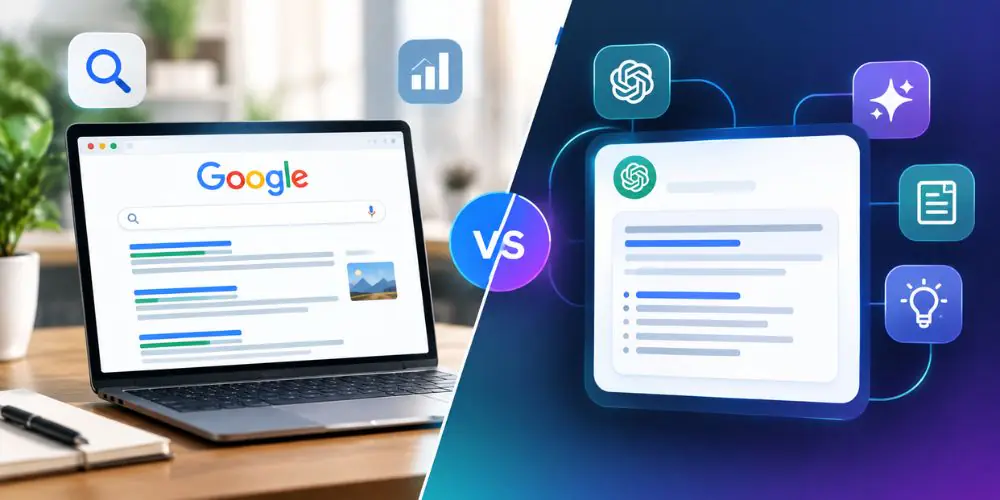
That shift is why business owners and marketing managers keep asking the same question: is ChatGPT actually replacing Google, and what does that mean for SEO? Google has held the default spot for close to two decades, and that position only started facing real competition once ChatGPT arrived in November 2022 and, later, added live search of its own. This post works through where search behaviour is actually moving, what that’s doing to SEO, and what it means for a business trying to stay visible in both places.
How ChatGPT and Google Search Actually Work
The two platforms feel like they’re competing for the same job, answering your questions, but they’re built on almost opposite foundations.
Google
Google works on a simple three-step process: crawl, index, rank. Bots are constantly scanning the web, an index stores what they find, and a ranking algorithm sorts everything by relevance, authority, and a few hundred other signals only Google fully understands. Two things stand out about this system. It’s built for freshness, so a news story from ten minutes ago can already be sitting on page one. And it’s built for scale, handling billions of searches a day in every language and region. Google makes its money from ads sold at auction on high-intent searches, which is also why it’s so strong at local results, shopping listings, and anything transactional.
ChatGPT
ChatGPT works on a different model entirely. At its core, it’s built for reasoning and generating text, not for crawling and indexing the web. When it needs current information, it uses a browsing layer that reads pages live, on the spot, rather than searching a pre-built index the way Google does. There’s no standing crawl of the entire internet behind it. It fetches what it needs in the moment, inside a conversation that keeps context from one message to the next. That’s why it handles multi-step reasoning and follow-up questions so well, but it also means its sense of what’s happening right now is usually thinner than Google’s.
Key Differences That Actually Matter
Google gives you a list of results and leaves the decision to you. ChatGPT gives you one answer and expects you to either trust it or question it. That’s a different relationship with the user, one gives you the raw material to work with, while the other gives you a conclusion.
Google also forgets what you searched for between searches unless you’re logged in and it’s tracking your search history. ChatGPT doesn’t. It remembers your recent messages, and with memory turned on, often a lot more than that. Ask a follow-up and it knows what “the second one” or “that other approach” means. Try that on Google and you’re typing the whole query again from scratch.
Google still has a clear advantage when you need real-time information, such as stock prices, sports scores, store hours, or local product availability. ChatGPT is better suited to tasks that involve bringing information together, explaining things step by step, or creating something new.
Is ChatGPT Replacing Google as a Search Engine?
Short answer, no. ChatGPT is not replacing Google, at least not in the way many people assume. Google still dominates overall search volume. As of December 2025, Google accounted for 77.9% of total digital queries, compared with 17.1% for ChatGPT (source).
While Google remains far ahead across the overall search landscape, ChatGPT has emerged as its biggest challenger. However, Gemini’s recent growth has changed the picture. Its market share increased from 5.7% to more than 21.5% within a year, while ChatGPT’s share declined. This shows how Google is using AI across its ecosystem to retain users and strengthen its position in search (source).
Google’s core strength is indexing and ranking live web content, which makes it especially useful for e-commerce and service-based businesses. Its search model is built around giving users options. You get a list of ranked results, compare different sources, check credibility, and visit websites directly. That makes Google particularly strong when someone is looking for a product, service, business, or a specific website.
ChatGPT works differently. Instead of acting as a directory of websites, it works more like an AI assistant that brings information together and turns it into a conversational answer. Rather than giving you a list of links, it can explain something, summarise information, make recommendations, or answer a question based on the context of the conversation.
That makes ChatGPT especially useful for informational and research-based queries. But when people want to browse products, compare businesses, find a service, or visit a specific website, Google still has the advantage.
How Do People Actually Use ChatGPT vs Google Today?
The clearest way to see the difference is to look at what people actually search for on each platform. Google still dominates navigational and transactional searches: “nearest pharmacy,” “flight status,” “cheapest flights to Lisbon,” or “[brand] customer service number.” These are searches where people already know roughly what they want and just need the quickest way to find it. Real-time searches are also still largely a Google or dedicated app habit, especially for things like sports scores, breaking news, stock movements, and other information that changes constantly.
ChatGPT is used for a different type of question. Many people use it for personal tasks rather than work. They use it to help with writing, understand a topic, make a decision, or simply talk through an idea. The questions people ask ChatGPT are also usually longer and more detailed than Google searches. A Google search might be only three or four words. A ChatGPT prompt is often a full sentence or paragraph that explains the situation, what the person needs, and what they want to achieve.
Why Google Still Dominates High-Intent and Commercial Searches
There’s a reason no one is telling a local plumbing business to stop focusing on Google Business Profile and start focusing on ChatGPT instead: Google is still much better at handling searches where people are ready to buy or book a service.
Local search is the clearest example. Google Maps, verified business listings, opening hours, and reviews all work together in local search. No other platform offers the same level of local information. When someone searches for a “plumber near me,” Google can use their location to show nearby businesses and which ones are open right now.
Shopping works in a similar way. Google Shopping uses live product prices and stock information from retailers. So when someone searches for a specific product, they can see real prices from real sellers and buy it straight away. ChatGPT can explain products and make recommendations, but it does not have the same level of access to live shopping data, at least not yet.
What Are Zero-Click Searches, and How Does AI Accelerate Them?
A zero-click search is exactly what it sounds like, the user gets the answer directly on the search results page and never visits a website. This has been happening for years because of featured snippets, knowledge panels, and direct answer boxes. AI Overviews have made the trend even stronger. Depending on the type of search, many searches now end without the user clicking on an external website. The exact rate varies by category, but it is high enough that ranking #1 no longer always means getting the visit.
When an AI Overview appears above the regular search results, the number of clicks on the organic listings below it often drops sharply. In some cases, it can fall by half or more compared with searches where no AI Overview appears. The information still has to come from somewhere, often from the same websites that used to receive the click, but the user no longer needs to visit that website.
This is not an argument against ranking well. It is an argument for looking beyond clicks when measuring SEO success. If an AI Overview or ChatGPT answer uses your website as a source, your brand can still gain visibility and trust even if the user never visits your site. It is simply a different type of result, and it requires different ways of measuring success.
Can ChatGPT Drive Traffic or Leads to Websites?
Yes, but mostly as part of the customer journey rather than as a replacement for Google or your website.
A user might ask ChatGPT which service is best, compare a few options, or ask for recommendations. This can help a business get noticed and influence the user before they ever visit a website.
But the website still plays the main role once that interest is created. It gives users the full information they need, builds trust, and gives them a place to make an inquiry, book a service, or buy a product.
This also makes website content more important. AI tools use information from across the web to understand businesses and answer questions. Businesses across different industries that publish clear, useful, and well-optimised content have a better chance of being mentioned or influencing AI-generated answers.
That is where AI SEO fits alongside traditional SEO. The goal is not to choose one over the other. A strong website and useful content can help your business stay visible in both search results and AI answers.
Is SEO Still Worth Investing In as AI Search Grows?
AI is changing how people search, but that does not mean SEO is becoming less important. If anything, businesses now have more places to be found. Google is still important for traditional search, while AI tools are creating another way for people to discover businesses, products, and information.
That means SEO is no longer only about ranking higher on Google. It is also about creating useful content that AI systems can understand, trust, and use in their answers. This is where generative engine optimisation (GEO) becomes important.
As search habits change, businesses that stick to old approaches could lose visibility. Adapting to both traditional and AI search gives businesses more ways to reach potential customers. At Growth Metrics Ltd, our team helps businesses build SEO strategies that keep up with these changes and focus on where their customers are actually searching.
How ChatGPT and Google Could Change Search by 2027
Nobody has a clear answer yet, and forecasts vary. Some expect a small drop in organic traffic, while others predict a much larger decline as AI search grows.
What is clear is that search is changing. Google is expanding its AI features, ChatGPT is growing, and AI tools are starting to do more than just answer questions.
The most likely outcome is not one platform replacing the other. Search will continue to spread across Google, AI chat, and other specialised tools. For businesses, being visible across more than one channel will become increasingly important.
Quick Comparison Table
Feature
Google Search
ChatGPT
Best for
Local searches, buying decisions, and real-time information
Research, writing, and solving complex questions
How it makes money
Search ads
Subscriptions and early advertising tests
Real-time data
Strong
Depends on live information access
Personalisation
Search history, location, and device
Conversation and memory
Source transparency
Ranked list of websites
Citations within answers, but can be limited
Local and shopping data
Strong through Maps and Shopping
More limited and often depends on other sources
User base
Billions of searches each day
Hundreds of millions of users each week
Ready to Improve Your Visibility Across Search and AI?
Google and ChatGPT serve different search needs, so businesses need a strategy that supports both. Growth Metrics Ltd provides SEO services to improve your website’s rankings, content and technical performance. Our AI SEO services help your business adapt to AI-powered search and improve how your brand is understood across platforms such as ChatGPT and Google.
Get in touch with Growth Metrics Ltd to build a search strategy that helps your business remain visible as search continues to evolve.
The Bottom Line
Google and ChatGPT are not doing exactly the same job. Google helps you find the right place quickly, while ChatGPT helps you understand something, explore an idea, or work through a problem. The overlap between the two is growing, and that is where new challenges and opportunities are appearing.
If you manage a brand’s visibility, the practical approach is not to choose one over the other. Check whether your brand appears when people ask AI tools about your industry, and use what you find to shape the next part of your SEO strategy.