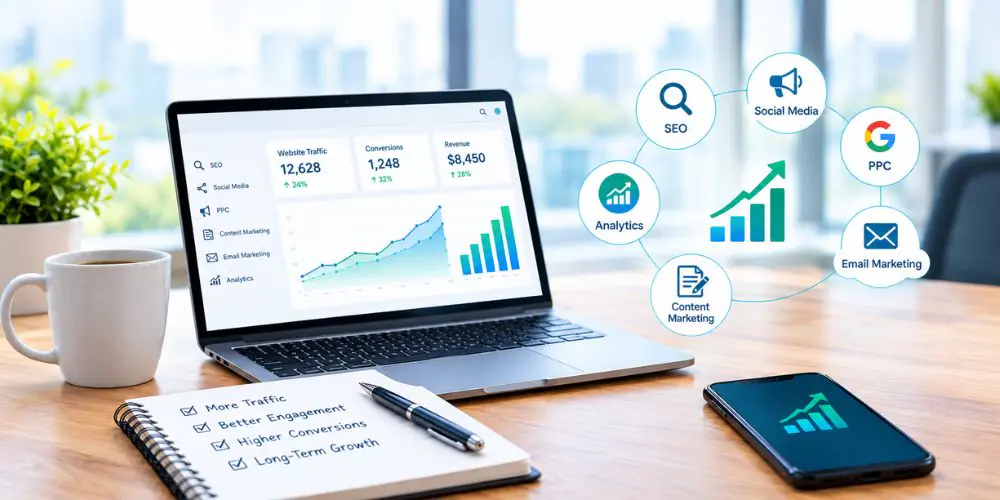
10 Effective Digital Marketing Strategies for Business Growth

Publishing social posts, running advertisements and writing blog articles can keep a marketing team busy. But activity alone does not tell you whether your business is attracting suitable customers.

Effective digital marketing strategies connect your business goals with your audience, your message and the channels you use. They also provide a way to assess whether your work leads to enquiries, sales or repeat business.

The right approach depends on what you sell, how customers choose it and the resources available to you. A local electrician, an online clothing shop and a business consultancy will rarely need the same marketing plan.

This guide explains ten practical strategies, when each can help and how to bring them together into a manageable plan.

What is a Digital Marketing Strategy?

A digital marketing strategy is a plan for reaching business objectives through online channels. It identifies the customers you want to reach, the problems you help them solve and the actions you want them to take. It also explains how you will allocate resources and measure progress.

A strategy differs from a tactic. Publishing a video is a tactic. Using product demonstration videos to help hesitant shoppers understand an unfamiliar product is part of a strategy. A useful plan answers five questions:

  • Who are we trying to reach?
  • What do those customers need?
  • Why should they choose our business?
  • Where can we reach them effectively?
  • How will we know whether the approach is working?

These answers should guide your channel choices before you invest heavily in content or advertising.

Build Your Foundations Before Choosing Channels

Marketing channels cannot compensate indefinitely for an unclear offer, a broken website or poor follow-up. Before launching campaigns, establish a business goal and check the customer journey.

Set a Specific Business Objective

“Get more visibility” is difficult to evaluate on its own. Connect visibility to an outcome that matters. For example, a fictional consultancy might aim to increase qualified consultation enquiries from 15 to 20 per month over the next quarter. That is a planning target, not a predicted result.

Define what makes an inquiry qualified. Consider service requirements, budget, location and the customer’s ability to make a purchasing decision.

Understand Your Audience

Review customer conversations, sales enquiries, support questions and reasons for lost business. Look beyond basic demographics. Find out what triggers a search, what customers compare and what prevents them from buying.

An accountancy firm may discover that prospective clients care more about responsiveness and clear fees than a long list of technical services. Its messaging should reflect that insight.

Check Your Offer and Website

Explain what you provide, who it suits and how customers take the next step. Test forms, booking systems and checkout processes. Confirm that enquiries reach the right person and receive a timely response. Once these foundations work, choose the strategies that best fit your business.

1. Use SEO to Reach Customers with Relevant Search Intent

Search engine optimisation services helps your website compete for unpaid visibility when people look for relevant information, products or services.

It can be useful where customers already search for what you offer. However, not every search attracts the same type of visitor.

Someone searching for “what is payroll software?” may be learning. Someone searching for “payroll software for a small UK business” may be comparing options.

Start with Important Commercial Pages

Make your main service, product and category pages clear and useful. Explain the offer, relevant pricing information, suitability and next steps. Address common concerns rather than relying on a short paragraph filled with keywords. Support these pages with sensible navigation and internal links.

Create Helpful Supporting Content

Use guides, comparisons and practical explanations to answer questions that arise before a purchase. Google’s guidance emphasises helpful, reliable content created for people. It encourages publishers to assess originality, evidence and whether a visitor receives a satisfying answer.

Measure Relevant Outcomes

Review which queries bring visitors and which pages generate useful enquiries. More traffic is valuable when it helps reach the right audience. A highly visited article unrelated to your services may contribute little to your commercial goals.

2. Create Content That Helps Customers Make Decisions

Content marketing gives prospective customers useful information before they are ready to contact you. A practical content plan follows the customer’s questions rather than filling a calendar with loosely related topics. Consider three stages:

Customer stage Useful content
Understanding a problem Explanations, tutorials and diagnostic guides
Comparing solutions Comparisons, pricing factors and selection checklists
Choosing a provider Case studies, demonstrations and process explanations

Answer Difficult Questions Clearly

Topics such as cost, limitations, suitability and alternatives can be especially useful because they address uncertainty. A website design agency could explain what affects project cost, which materials a client must provide and when a template-based website may be sufficient. That information helps readers judge the service before booking a call.

Add Evidence from Your Work

Use genuine examples, original photographs, demonstrations and relevant experience. A case study should explain the starting problem, the work completed and the outcome. Separate measured results from assumptions, and obtain permission where needed.

Choose a Sustainable Publishing Schedule

There is no universal requirement to publish a particular number of articles each week. Choose a pace that allows research, editing and useful updates. One strong guide may serve customers better than several rushed posts. Plan distribution alongside creation so useful content reaches its intended audience.

3. Use Paid Advertising to Test Demand and Attract Enquiries

PPC advertising can help you reach customers while building other channels. It also provides a way to test specific offers and messages. The important question is whether the traffic produces valuable outcomes at an acceptable cost.

Match the Advertising Channel to the Buying Situation

Search advertising may suit a service customers actively look for, such as commercial cleaning or appliance repairs. Social advertising may suit products that benefit from visual demonstration or discovery, such as home accessories or a new clothing collection. Start with a clear reason for choosing a channel.

Match the Landing Page to the Advertisement

If an advertisement promotes a particular service, send visitors to a page explaining that service. The page should carry through the offer, provide relevant evidence and make the next step obvious. Sending every campaign to a general homepage can create unnecessary confusion.

Measure Actions Before Increasing Spend

Define and test your conversion measurement. Google Ads supports measurement of valuable actions such as purchases, website enquiries, phone calls and relevant offline outcomes. Check lead quality as well as lead quantity. Cheap enquiries are not necessarily useful enquiries. Agree on a test budget and review criteria before launching. Increase spending when results justify it rather than because clicks are rising.

4. Use Email Marketing to Support Follow-Up and Repeat Business

Email can help maintain relationships with people who have chosen to hear from your business. It is particularly useful when customers need time to decide or when repeat purchases form an important part of the business.

Segment Messages by Customer Needs

A new subscriber, an active customer and someone interested in a specific service may need different information. Keep segmentation manageable. Start with meaningful distinctions rather than collecting information you will not use. For example, a training provider could separate enquiries about introductory courses from those about advanced training.

Build Useful Email Sequences

A welcome sequence can explain what subscribers will receive and direct them to helpful resources. A service enquiry sequence might answer common questions and explain the consultation process. A customer sequence might provide onboarding advice or relevant maintenance reminders. Each message should have a clear purpose.

Assess Newsletters by Their Value

A newsletter can be useful when subscribers expect and value it. Its effectiveness depends on the audience, content and purpose. Avoid sending messages merely because a date appears on the calendar. Make sign-up expectations clear, respect communication preferences and provide an easy unsubscribe option. Judge performance through useful clicks, enquiries and customer outcomes, alongside list health.

5. Choose Social Media Channels Your Audience Actually Uses

Social media can support discovery, demonstrate expertise and create conversations with customers. The best platform for your business is the one where you can reach a relevant audience with content you can produce well.

Give Each Platform a Purpose

A professional consultancy might use LinkedIn to discuss business problems and share expert perspectives. A furniture retailer might use visual platforms to show products in real homes. These are possible approaches to test, not rules for every business. Start with one or two platforms you can maintain properly.

Build Repeatable Content Themes

Useful themes might include customer questions, demonstrations, work examples and behind-the-scenes explanations. A landscaping company could show project stages, explain maintenance choices and answer questions about drainage or planting. This creates a recognisable purpose for the account.

Connect Attention to a Next Step

Make business details and relevant links easy to find. Where appropriate, direct people to a guide, product page, event registration or enquiry form. Monitor meaningful conversations and website actions alongside reach. A smaller relevant audience can be more valuable than a larger audience with little interest in buying.

6. Use Video to Explain and Demonstrate

Video can help customers understand something that is difficult to communicate through text alone. It may show how a product works, explain a service or demonstrate the experience a customer can expect.

Start with a Real Customer Question

Useful video topics include:

  • How does this product work?
  • What happens during an appointment?
  • Which option suits my needs?
  • What should I prepare before installation?

Choose the format and length around the answer.

A short demonstration may work well for a simple product feature. A detailed tutorial may need more time.

Prioritise Clarity

Good lighting, clear sound and a focused explanation matter more than elaborate production. Use captions where appropriate and show the product or process accurately. Avoid unsupported performance claims and customer testimonials that imply results everyone will receive.

Repurpose Thoughtfully

A detailed demonstration can supply shorter clips, website explanations and social posts. Edit each version for its audience and context. A clip should still make sense when viewed without the original video.

7. Improve Conversion Rates on Your Website

Conversion rate optimisation improves how effectively your website helps suitable visitors take action. Before attracting more traffic, check whether existing visitors encounter avoidable obstacles.

Identify Friction

Review the experience on mobile and desktop. Can visitors understand the offer quickly? Are prices or pricing factors clear? Do forms ask for unnecessary information? Are delivery details hidden until late in checkout?

Use enquiries and customer feedback to identify uncertainty.

Strengthen Relevant Trust Signals

Place genuine evidence near important decisions. This might include qualifications, product specifications, customer reviews, work examples or clear returns information. Choose evidence that addresses the customer’s concern. A service buyer may need to understand the process, while a shopper may need sizing guidance.

Test Changes Carefully

Start with a clear hypothesis. For example: “Explaining what happens after an enquiry may encourage suitable visitors to submit the form.” Avoid changing several unrelated elements and then assuming one caused an improvement. Where traffic is limited, combine measured behaviour with customer feedback. Do not declare a small fluctuation a proven result.

8. Build Credibility Through Partnerships, Referrals and Digital PR

Relevant partnerships can introduce your business to an audience that already trusts another organisation. Consider complementary businesses, professional associations, specialist publications and community networks.

Offer Something Useful

A photographer and an event venue might produce a planning resource together. A software provider might share an original study with an industry publication. The collaboration should benefit the audience and make sense for both organisations.

Make Referrals Easy

Explain who your service suits and how someone can introduce a prospective customer. Ask at an appropriate point in the relationship, such as after successful delivery. If you run a referral offer, keep the terms clear and separate it from public review requests.

Evaluate Audience Fit

A publication mention or partnership should be assessed through relevance, referrals and enquiries. A large audience is not automatically the right audience. Prioritise credible relationships connected to your market.

9. Use AI and Automation for Specific Marketing Tasks

AI can assist with drafting, organising information and generating ideas. Automation can make established processes more consistent. Begin with a task that already has a clear purpose.

Choose Practical Uses

Examples include:

  • Turning approved product details into initial copy variations.
  • Organising recurring questions into content topics.
  • Creating a first draft of an email sequence.
  • Routing enquiries to the appropriate team.
  • Sending an internal reminder when a lead needs follow-up.

Review the output against accurate business information.

Keep Human Review in the Process

Check claims, examples, tone and suitability before publishing. Do not invent customer stories, qualifications, reviews or results to make content appear credible. Google’s guidance asks publishers to consider who created content, how it was produced and why it exists. The focus should remain on useful content for the audience.

Automate a Process You Understand

A broken process can become more frustrating when automated. Define the trigger, action, exceptions and responsible person first. Ensure customers can reach a human when the situation needs judgement.

10. Use Measurement to Improve Your Strategy

Measurement helps decide what to keep, change or stop.

Start with the business outcome and work backwards to the indicators that help explain it.

Objective Useful measures
Generate enquiries Qualified leads, cost per qualified lead, lead-to-sale rate
Increase online sales Purchases, acquisition cost, order value and margin
Encourage repeat business Repeat purchase rate and retention
Improve relevant visibility Target-audience reach and relevant search discovery
Improve the website Conversion rate and successful customer journeys

Distinguish Leads from Customers

An enquiry is an intermediate step. Track whether it is suitable, whether the sales team responds and whether it becomes business. This helps identify a campaign that generates interest but little commercial value.

Calculate Costs Consistently

Suppose a fictional campaign spends £1,000 on advertising and generates 20 qualified leads. Its advertising cost per qualified lead is £50. If five become new customers, its advertising-only acquisition cost is £200.A broader acquisition calculation should also consider relevant agency fees, creative work and other costs. Revenue alone does not show profit. Compare results with margins and the cost of delivering the product or service.

Recognise Measurement Limits

Customers may encounter several channels before buying. Different reporting systems may credit the same purchase differently. Use analytics alongside sales records and customer feedback. Avoid treating one platform’s attribution report as a complete account of what caused each sale.

How to Choose the Right Marketing Mix

Choose channels according to demand, buying behaviour and available resources.

Business situation Possible starting mix
Customers actively search for the service SEO, search advertising and focused landing pages
Products need visual explanation Demonstration video, visual social content and suitable paid tests
Buyers need time to compare Educational content, email follow-up and case studies
Local appointments drive revenue Local SEO, booking improvements and customer retention
Repeat purchases matter Email, customer experience and relevant replenishment reminders

These combinations are starting hypotheses. Review them against your own results.

With a small budget, concentrate on a manageable number of channels. Account for the time needed to create content, handle enquiries and maintain campaigns. Organic marketing still requires resources. Paid marketing still requires a useful offer and customer experience.

Build a Strategy You Can Maintain

Begin with a clear objective, a specific audience and an offer customers understand. Choose a manageable combination of channels, make the customer journey dependable and measure what happens after people engage.

Use the findings to improve your next decisions. A strategy becomes more useful as it reflects your customers, your capacity and the evidence from your own business.

Get Your Digital Marketing Audit

Discover where your digital marketing can improve. Growth Metrics Ltd can review your SEO, website, content and paid campaigns to identify gaps and recommend practical next steps aligned with your business goals. Contact Growth Metrics Ltd to request your digital marketing audit.

Conclusion

Effective digital marketing strategies start with understanding your audience, setting clear goals and choosing channels that suit your business. SEO, content, email, social media and paid advertising each have a role, but their value depends on how well they help you attract and convert suitable customers.

Start with a manageable plan, track meaningful results and use what you learn to improve. If you need help identifying your next steps, Growth Metrics Ltd can review your digital marketing and recommend practical priorities aligned with your business goals.

What is AI in Digital Marketing? A Complete Guide

Artificial intelligence is changing the way businesses approach digital marketing. From creating content and analysing customer behaviour to improving advertising campaigns and answering customer questions, AI is becoming part of many everyday marketing tasks. You may already be using AI without realising it. Product recommendations, personalised emails, chatbots, targeted adverts and search results can all use AI to understand what people are looking for and predict what they may do next. But what does AI in digital marketing actually mean? How is it used, and does it replace the work of digital marketers? In this guide, we’ll explain what AI in digital marketing is, how it works, where businesses are using it, its main benefits and challenges, and how you can start using AI in your own marketing strategy.

What is AI in Digital Marketing?

AI in digital marketing means using artificial intelligence to help plan, create, manage and improve marketing activities. AI systems can process large amounts of data, find patterns, make predictions and automate certain tasks. This helps marketers to spend less time on repetitive work and more time on strategy, creativity and customer needs. For example, a business could use AI to:
  • Find topics for new content
  • Analyse customer behaviour
  • Personalise website content
  • Write a first draft of an email
  • Suggest social media ideas
  • Analyse advertising results
  • Answer common customer questions
  • Identify potential customers
  • Predict which products a customer may be interested in
AI does not mean handing your entire marketing strategy over to a machine. It is better viewed as a tool that helps marketers work with information and complete certain tasks faster.

How Does AI Work in Digital Marketing?

AI uses data and algorithms to identify patterns and make predictions or generate content. For example, an online shop may have data about the products customers view, the products they buy and how they interact with the website. AI can analyse this information and identify patterns in customer behaviour. A business can then use those insights to show more relevant products, send personalised emails or improve its advertising. There are several types of AI that are useful in digital marketing.

Generative AI

Generative AI creates new content based on the instructions and information it receives. Marketers can use tools such as ChatGPT to generate blog ideas, draft content, write emails and social media posts, create ad copy and images, summarise information and produce different content variations. These tools can support content creation and research tasks, but their output should still be reviewed for accuracy and quality.

Automation

AI can also automate repetitive marketing tasks. This can include sending follow-up emails, organising customer information, analysing campaign data and responding to common questions. The goal is not simply to automate everything. The useful part is removing repetitive work where automation can save time without reducing the quality of the customer experience.

AI Agents

AI agents are a newer development in marketing. Instead of only responding to a prompt, an AI agent can be given a task and work through several steps to complete it. For example, an AI agent could help research customer information, identify an opportunity and prepare a recommendation for a marketer to review.

How is AI Used in Digital Marketing?

AI can be used across almost every major part of digital marketing. Here are some of the most common examples.

1. AI for Content Marketing

Content marketing is one of the most common parts where businesses use AI. AI can help marketers come up with ideas, organise research, create outlines, write first drafts and adapt existing content for different channels. For example, a marketer could use AI to turn a long blog post into:
  • A LinkedIn post
  • Several social media captions
  • An email
  • A short video script
  • A list of key points
This can save time when repurposing existing content. However, AI-generated content still needs human review. Marketers need to check facts, add useful experience and make sure the content actually helps the target audience. The strongest approach is to use AI to support content creation rather than publishing everything it produces without checking it.

2. AI for SEO

AI is also becoming part of SEO. Marketers can use AI to support:
  • Keyword research
  • Search intent analysis
  • Topic research
  • Content planning
  • Competitor research
  • Content optimisation
  • Internal linking
  • Content gap analysis
AI can help process large amounts of information quickly, but it does not remove the need for SEO knowledge. A marketer still needs to understand the business, its customers, search intent and what makes the website different from its competitors. AI is also changing the way people search. As AI search tools and AI-generated answers become more common, businesses need to think about how their content can be found and understood across both traditional search engines and AI platforms. This is where areas such as answer engine optimisation (AEO) and generative engine optimisation (GEO) are becoming more relevant.

3. AI for Social Media Marketing

Social media teams can use AI to speed up many everyday tasks. AI can help with:
  • Post ideas
  • Caption writing
  • Content planning
  • Audience research
  • Social listening
  • Performance analysis
  • Content variations
  • Basic customer responses
For example, a business could give an AI tool information about a new product and ask it to create several social media post ideas for different audiences. The marketer can then choose the strongest ideas, edit them and make sure they match the brand’s voice. AI can also help analyse which types of posts receive the most engagement and identify patterns in audience behaviour.

4. AI for Email Marketing

Email marketing can benefit from AI because businesses often have large amounts of customer and engagement data. AI can help marketers:
  • Write subject lines
  • Create email drafts
  • Group customers into different audiences
  • Personalise messages
  • Suggest when emails should be sent
  • Analyse email performance
  • Create different versions of campaigns
Instead of sending exactly the same email to everyone, businesses can use customer data to make messages more relevant. For example, an online retailer could send different product recommendations based on what customers have previously viewed or purchased.

5. AI for Paid Advertising

AI is widely used in online advertising. Advertising platforms can use AI to analyse user behaviour, identify audiences and help decide where advertising budgets should be placed. Marketers can also use AI to:
  • Create ad copy
  • Generate creative ideas
  • Test different messages
  • Identify better-performing audiences
  • Analyse campaign results
  • Find patterns in advertising data
This can make campaign management faster, especially when a business is running many ads at the same time. However, marketers still need to set clear goals and monitor results. AI can help optimise a campaign, but it cannot decide what makes an offer valuable to a customer.

6. AI for Customer Service

AI-powered chatbots can help businesses answer common customer questions. For example, a customer might ask:
  • What are your opening hours?
  • Where is my order?
  • What services do you offer?
  • How much does delivery cost?
  • How can I book an appointment?
An AI chatbot can answer simple questions without requiring a member of staff to respond every time. This can make customer support faster, especially outside normal business hours. However, more complicated problems may still need a human. A good customer service system should make it easy for customers to reach a person when the question requires human judgement.

7. AI for Marketing Analytics

Digital marketing creates a huge amount of data. Businesses can track website visits, clicks, conversions, advertising costs, customer behaviour and many other metrics. AI can help marketers analyse this information and identify patterns more quickly. For example, AI could help identify:
  • Which campaigns are performing well
  • Which customers are more likely to convert
  • Where a campaign is losing potential customers
  • Unusual changes in performance
  • Which channels are producing the best results
This can help marketers make decisions based on data rather than relying only on assumptions.

What are the Benefits of AI in Digital Marketing?

AI can offer several benefits when it is used correctly.

Saves Time

AI can handle many repetitive tasks that would otherwise take marketers hours to complete. This gives marketing teams more time to focus on planning, creativity and strategy.

Helps Analyse More Data

Businesses collect large amounts of marketing data. AI can process this information much faster than a person working manually. This can help marketers find patterns and useful insights.

Improves Personalisation

AI can help businesses understand customer behaviour and create more relevant experiences.

Supports Better Decisions

AI can identify patterns and provide insights that can help marketers make better decisions about campaigns, audiences and content.

Helps Scale Marketing

A small marketing team can use AI to support more tasks without having to manually complete every part of the process.

Supports Faster Campaigns

AI can help with research, content creation, testing and reporting, help businesses to move from an idea to a campaign more quickly.

What are the Challenges of Using AI in Digital Marketing?

AI also has some risks and limitations. Businesses should understand them before using AI across their marketing.

Inaccurate Information

AI can generate incorrect information. This is why AI-generated content should always be reviewed before it is published or used to make important decisions.

Privacy Concerns

AI systems often rely on data. Businesses need to be careful about how they collect, store and use customer information. Customer data should be handled responsibly and according to relevant privacy requirements.

Poor-Quality Content

AI can produce content quickly, but more content does not always mean better content. If businesses publish generic or repetitive AI content without adding real value, their marketing can become less useful.

Lack of Human Judgement

AI can identify patterns and generate ideas, but it does not fully understand a business, its customers or its brand in the same way a human team does. Human judgement is still important for strategy, creativity and important decisions.

Over-Reliance on AI

Using AI for everything can create problems. Businesses should identify where AI genuinely helps instead of adding AI to tasks simply because the technology is available.

AI vs Traditional Digital Marketing

AI does not completely replace traditional digital marketing. Instead, it changes how many tasks are carried out.
Area Traditional Approach AI-Powered Approach
Content Mostly created manually AI can help with research, ideas and first drafts
Data analysis Manual reports and analysis AI can identify patterns and trends
Personalisation Basic audience groups More detailed, behaviour-based personalisation
Email marketing Pre-set campaigns AI can support segmentation and timing
Advertising Manual testing and optimisation AI can help with targeting and campaign optimisation
Customer service Mainly human support AI can handle common questions with human support when needed
SEO Manual research and analysis AI can support research, planning and optimisation
The important point is that AI and traditional marketing do not have to compete with each other. A strong marketing strategy can use AI where it saves time or provides useful insights while keeping humans responsible for the important decisions.

Best Practices for Using AI in Digital Marketing

The best results often come from using AI alongside human knowledge and a clear marketing strategy. Here are some practical tips:
  • Use AI to support your team rather than replace it.
  • Give AI clear instructions and useful information.
  • Always check important facts.
  • Protect customer and business data.
  • Keep your brand voice consistent.
  • Add your own experience and expertise to AI-generated content.
  • Test AI-supported campaigns before launching them.
  • Track the results instead of assuming AI is working.
  • Keep reviewing how your customers respond.
  • Use AI where it solves a real marketing problem.

Will AI Replace Digital Marketers?

No. AI is more likely to change the role of digital marketers than remove it completely. AI can already help with repetitive tasks, data analysis, content drafts, campaign testing and customer responses. But businesses still need people to decide what they want to achieve, who they want to reach and how they should communicate with their audience. Human marketers also bring creativity, experience, brand knowledge and judgement.

What is the Future of AI in Digital Marketing?

AI will likely become a more common part of everyday marketing. We can expect to see more use of:
  • Personalised customer experiences
  • Predictive analytics
  • Automated marketing workflows
  • AI-powered ads
  • AI search and recommendations
  • AI content creation
  • Customer service automation
  • AI agents that complete multi-step tasks
  • Data-driven marketing decisions
AI agents are already becoming an important area of development because they can do more than generate a response. They can work through a task using approved information and instructions. At the same time, businesses will need to pay more attention to privacy, data quality, accuracy and responsible AI use. The future of digital marketing is unlikely to be completely human or completely automated. It will be a combination of both.

Why Human Expertise Still Matters

AI can process information quickly, but speed does not automatically mean quality. A good marketer understands the customer, the business and the market. They understand which messages are more likely to connect with their audience and which claims should be avoided. Human review is important because AI can make mistakes or provide information that sounds right but is incorrect. The strongest digital marketing strategies combine the speed and data-processing ability of AI with human experience, creativity and judgement.

Ready to Grow Your Business with AI-Powered Marketing?

AI can help your business save time, understand customer behaviour, create useful content and improve marketing campaigns. However, the best results come from using AI as part of a clear strategy, with human expertise guiding important decisions. At our digital marketing agency, we help businesses apply AI across every part of their digital strategy. Our SEO services and ecommerce SEO help your website and products appear in traditional and AI-powered search. Our AI SEO services improve how search platforms understand your brand, while AI-supported content marketing helps you create useful, relevant content. We also use data to improve PPC advertising, develop user-friendly websites and support more effective digital campaigns. Contact our team to discuss how these services can help your business grow.

Conclusion

AI is changing digital marketing by helping businesses work with data, automate repetitive tasks, create content, personalise customer experiences and improve campaigns. But AI is not a replacement for a good marketing strategy. Businesses still need to understand their customers, create useful content, build trust and make good decisions. AI can help with many of the tasks around those goals, but human expertise remains important. The best approach is to start small, choose tasks where AI can provide real value and measure the results. As AI continues to become part of SEO, content, advertising, social media, email and customer service, businesses that learn how to use it properly can make their marketing faster, more useful and easier to scale.

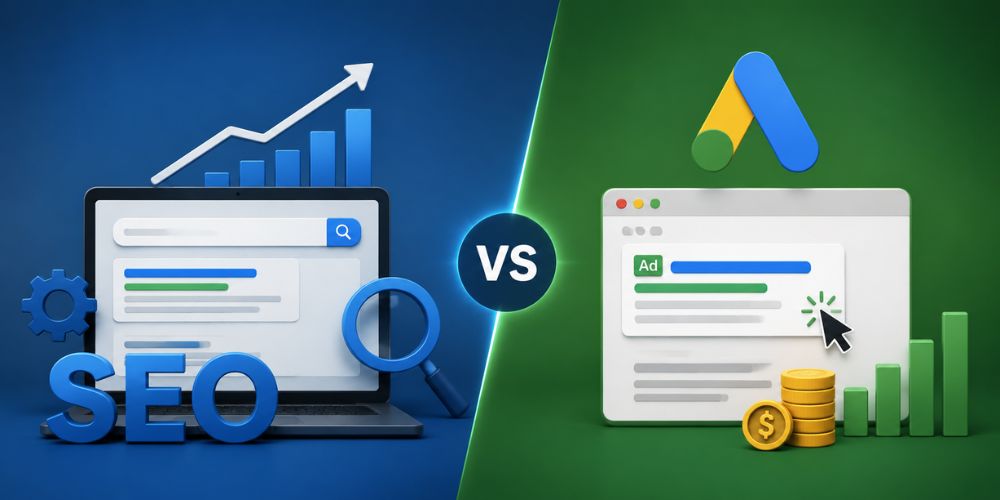
SEO VS Google Ads: Which Option Suits You Best 

When it comes to growing a business online, understanding the difference between SEO and Google Ads or AdWords is one of the most important decisions within any digital marketing strategy. Both channels compete for the same real estate on the SERP, yet they serve fundamentally different purposes. Search engine optimisation builds organic rankings and organic traffic over time with compounding value, while pay-per-click and PPC campaigns through online advertising deliver paid traffic and immediate sales by placing your brand directly in front of prospective customers the moment they search. The numbers speak for themselves, as the average conversion rate for organic search sits at 2.4%, compared to 1.3% for ad-click users, yet neither channel wins outright.

What is SEO?

SEO, or Search Engine Optimisation, is the process of improving your website’s visibility in organic search results on platforms like Google, so that when people search for products or services related to your business, your site appears prominently without paying for every click. It works by strengthening three core pillars:

  •  Technical performance, which ensures your website runs fast and functions correctly.
  •  Relevant content, which aligns your pages with the keyword clusters and user search queries your audience is actually typing.
  • Trust signals like inbound links, reviews, and domain authority that tell search engines your site is credible.

Unlike paid ads, SEO builds steady, sustainable traffic over months and years, and the payoff compounds the longer you invest, turning consistent content production, on-page optimisation, technical audits, and link acquisition into a long-term engine for brand awareness and organic leads.

What is Google Ads?

Google Ads is one of the most powerful paid advertising platforms available to businesses today. It helps businesses appear in Google search results and across Google’s wider partner network by using a pay-per-click model, where advertisers bid on keyword phrases and pay when users click on their ads.

Google Ads works by giving businesses control over three core areas:

  • Campaign reach: Allowing businesses to advertise through search ads, display campaigns, YouTube placements, and app campaigns.
  • Audience targeting: Helping advertisers reach the right people based on location, demographics, interests, behaviours, and search intent.
  • Performance tracking: Using conversion tracking to measure real results such as ROI, cost per acquisition, landing page performance, and campaign effectiveness.

What makes Google Ads especially valuable is its speed. New launches, seasonal offers, and time-sensitive promotions can gain visibility almost instantly without waiting for organic growth. Campaigns can also be paused, edited, tested, or scaled at any time, giving businesses full control over their budget and ad spend.

However, unlike SEO, Google Ads only delivers traffic while the campaign is active and funded. Once the budget runs out or the campaign is switched off, the traffic stops immediately. This makes ongoing campaign management, smart budget allocation, and performance optimisation essential for keeping customer acquisition costs aligned with wider business goals.

What are the Different Roles of SEO and Google Ads?

SEO and Google Ads each play a distinct but deeply complementary role in a well-rounded search marketing strategy. SEO focuses on building long-term authority and visibility through organic rankings by improving website content, technical performance, site design, and user experience so that Google recognises the site as relevant and trustworthy. This includes content creation through videos and infographics, smart content optimisation, link building, and making sure smooth navigation that keeps users engaged throughout the funnel. Google Ads, on the other hand, drives immediate brand exposure through paid search, using pay-per-click and online display advertising with precise keyword targeting to appear at the top of the SERP regardless of organic position. Together, they cover the full spectrum of search queries and customer engagement at every stage of the funnel:

  • SEO builds sustainable web presence and authority over time through content strategy, technical performance, and link building.
  • Google Ads delivers instant visibility and performance by targeting high-intent search queries with paid placements.
  • Combined, they maximise SERP coverage, reinforce brand exposure, and create a digital strategy where organic search and paid search continuously support each other’s results.

SEO vs Google Ads: Which Works Better?

SEO and Google Ads both drive traffic, but they serve very different purposes depending on where you are in your growth journey. Google Ads delivers immediate traffic the moment your campaign goes live, making it ideal for testing offers, validating messaging, and generating leads fast, especially when you need measurable, flexible results in a short-term window. SEO, on the other hand, builds organic authority over time, creating a steady pipeline of traffic that compounds without paying for every click, which dramatically lowers acquisition costs in the long run. The real question isn’t which one works better, it’s which one works better for your goal right now.

Here’s how each channel performs where it matters most:

  • Google Ads for Immediate Results: You can appear on page one today, drive traffic overnight, and start collecting performance data within days.
  •  SEO for Long-term ROI: SEO wins. Once you earn rankings, traffic flows consistently without ongoing spend, and organic authority is an asset that grows over time.
  • Google Ads for Lead generation on a budget: Google Ads gives you control and speed, but SEO reduces cost per acquisition significantly once it gains traction.
  • Testing and flexibility: Google Ads lets you pivot your messaging, targeting, and offers almost instantly, making it a powerful tool for experimentation.
  • Sustainable growth: SEO builds the foundation, turning your content strategy into a long-term traffic engine that doesn’t pause when the budget does.

The smartest digital marketing strategy uses both channels together. Ad performance data shows which keywords convert, which directly informs your SEO and content strategy. Strong organic rankings improve brand trust, which lifts click-through rates and Quality Scores on your paid campaigns, ultimately lowering costs across both. Rather than choosing between SEO and Google Ads, treat them as two complementary strengths working toward the same goal, more traffic, better leads, and stronger, more predictable growth.

Pros and Cons of Google Ads

Google Ads is one of the most powerful paid search platforms available today, giving businesses instant visibility in front of high-intent audiences through search and display advertising. By targeting the right keywords and crafting compelling ad copy, brands can drive qualified traffic almost immediately after a campaign goes live, making it especially effective for short-term promotions, product launches, and competitive markets where organic reach takes time to build. The platform’s granular audience targeting, including demographic targeting and placement controls, means your budget is directed toward the people most likely to convert. Layered on top of this is robust conversion tracking, which ties ad spend directly to real outcomes, allowing you to measure ROI with precision and make data-backed decisions on campaign management.

Pros

  • Instant Results: Campaigns go live quickly, driving traffic and leads from day one rather than waiting for organic growth.
  • Precise Audience Targeting: Reach specific demographics, locations, and placements with fine control over who sees your ads.
  • Measurable ROI: Conversion tracking links every click and leads back to ad spend, making performance data transparent and actionable.
  • Full Flexibility: Pause, adjust, or scale campaigns at any time, budget and strategy stay entirely in your hands.
  • Excellent for Testing: A/B test ad copy, keywords, and landing pages to continuously improve click-through rate and conversions.
  • Massive Reach: Access both search and display advertising across Google’s vast network, covering a huge share of online traffic.

Cons

  • Costs Add up Fast: Competitive markets push keyword bids high, meaning significant ad spend is needed to maintain meaningful visibility.
  • Ongoing Time Commitment: Effective campaign management demands regular monitoring, optimisation, and hours dedicated to performance reviews.
  • Traffic stops When the Budget Does: Unlike organic SEO, pausing campaigns instantly removes your visibility, there is no residual reach.
  • Steep Learning Curve: Getting the most from the ad platform requires deep knowledge of keywords, bidding strategies, and audience segmentation.
  • Diminishing Returns Over Time: Without constant optimisation, performance can plateau and cost per lead rises as competition intensifies.
  • Ad Fatigue and Blindness: Audiences exposed to the same ads repeatedly tend to tune them out, demanding fresh creative and ongoing testing.

Pros and Cons of SEO

SEO is one of the most powerful long-term channels available to any website. Done right, it builds organic visibility that compounds over time, driving consistent traffic without a recurring ad spend. But it comes with real trade-offs worth understanding before committing to it as a core strategy.

Pros

  • Compounding Organic Growth: Quality content and strong domain authority build on themselves, rankings improve over time, not overnight.
  • Reduced Dependence on Ad Spend: Once established, organic traffic flows without paying per click, freeing budget for other investments.
  • Trust and Brand Credibility: High search rankings signal authority to users. Consistent visibility builds brand recognition and long-term trust.
  • Better User Experience: On-page SEO and technical SEO improvements, faster load times, cleaner structure, benefit real users too.
  • Stability at Maturity: A well-established site with strong keyword rankings and link building in place becomes resilient and self-sustaining.

Cons

  • Results take months: SEO is not a quick win. Meaningful movement in search rankings often takes 3–6 months or longer to materialise.
  • Algorithm dependency: Search engine algorithms update constantly. A single core update can shift rankings significantly, requiring rapid adaptation.
  • Ongoing content and technical upkeep: Content strategy, content updates, and site performance maintenance are continuous, not a one-time effort.
  • High initial investment: Building domain authority through quality content and link building demands significant time, skill, and often budget upfront.
  • No guaranteed returns: Even with a solid content strategy and technical SEO in place, rankings are never fully guaranteed or permanent.

Do Google Ads Help With SEO?

Many business owners assume that running Google Ads will somehow boost their organic rankings, but that is not how search works. Google has confirmed repeatedly that paid spend through AdWords has zero direct influence on where your website appears in organic search results. The two systems operate on entirely separate tracks. What Google Ads genuinely does, however, is give your brand immediate Page 1 visibility while your SEO strategy builds momentum in the background. That dual presence on the SERP, both a paid ad and an organic listing, signals authority and credibility to the consumer, and research consistently shows that combined visibility drives higher click-through rates and stronger engagement than either channel delivers alone.

Here is why a combined strategy protects and grows your web presence:

  • Paid search fills the gap while organic rankings are still climbing, keeping you visible in high-competition keyword territories from day one.
  • SEO builds compounding growth that paid ads alone can never replicate, reducing cost dependency over the long run.
  • Search query reports from ad campaigns reveal real audience language and intent, which directly informs stronger organic content.
  • Dual SERP presence reinforces brand credibility and authority, increasing the likelihood a user clicks regardless of which listing they land on.
  • Resilience across algorithm shifts means a zero-click search environment or ranking fluctuation hurts far less when you have both channels active.

For budget allocation, a proven digital strategy typically leans toward an SEO-weighted mix, directing roughly 60 to 70 percent toward organic growth and 30 to 40 percent toward paid search, scaling that ratio as organic rankings mature and begin to carry more of the traffic load.

When to Use Both

The smartest digital marketing strategies don’t choose between SEO and Google Ads,  they use both together. Running paid search and organic search in parallel turns each channel into a feedback loop for the other. Google Ads delivers immediate performance data on converting keywords, messaging, and acquisition costs, while high-ranking SEO pages reveal which topics carry real search intent worth spending on.

Here’s when combining both makes the most sense:

  • Competitive keywords are too slow to rank for organically,  paid search fills the gap while SEO traction builds.
  • SERP dominance increases when you hold both an ad position and an organic result simultaneously.
  • Ad performance data sharpens your keyword and content strategy before you invest months in organic growth.
  • Quality Scores improve when ads align with strong organic pages, lowering costs over time.
  • Lead generation speed up while acquisition costs drop as both channels compound together.

When SEO insights make your ads smarter and ad insights sharpen your content strategy, you stop running two separate campaigns and start running one unified growth engine.

When Should You Invest in SEO?

SEO makes the most sense when you’re building for the long term. If you’re in a trust-dependent industry like B2B services, legal, or finance, organic rankings do more than drive traffic, they build brand credibility and signal authority before a prospect ever reaches out. Unlike paid channels that stop the moment you cut budget, a well-executed SEO campaign compounds over time, turning keyword clusters and website content into lasting SEO assets with a longer lifespan and a lower long-term cost of acquisition.

SEO is especially worth prioritising when:

  • You rely on inbound leads and want a sustainable pipeline.
  • Paid channels are becoming expensive or unpredictable.
  • You’re in a high-trust industry where search rankings influence buyer decisions.
  • You want compounding ROI rather than renting attention month to month.

The bottom line: SEO isn’t a quick fix, it’s a sustainable strategy and a marketing investment that grows in value the longer you commit to it.

When Should You Invest in Google Ads?

Google Ads makes the most sense when you need speed. Whether you’re launching a new product, running a seasonal push, or simply testing a new market, paid search gets you visibility within days rather than waiting months for organic rankings to build. It works especially well in competitive markets where immediate demand already exists and you need to show up right now, not eventually.

You should strongly consider Google Ads when:

  • You have a clear budget and need results on a defined timeline.
  • Your SEO is still in early stages and organic rankings are months away.
  • You’re entering a competitive market where competitors are already running ad campaigns.
  • You want to test conversion rates on a new offer before scaling.
  • You need immediate demand capture, not awareness building.

The key is ROI clarity. Google Ads rewards intent, so if people are already searching for what you sell, ad spend converts far more efficiently than almost any other channel. Without that existing demand in the background, even the best campaign struggles to perform.

Work With an Agency That Has Mastered SEO and Google Ads

Most businesses pour money into SEO and Google Ads separately, with no strategy connecting the two. The result is wasted budget, conflicting data, and a growth ceiling you can’t seem to break through. The problem isn’t the channels, it’s running them in isolation. A unified search strategy uses paid data to sharpen your organic content and organic authority to lower your ad costs. When both channels work together, your cost per acquisition drops and your visibility compounds. That’s not theory, it’s exactly how sustainable search growth works in practice.

At Growth Metrics Ltd, we build integrated SEO and Google Ads strategies that turn search into your most reliable revenue channel. Our team brings together paid search specialists and SEO strategists who work as one unit, not two separate departments. The call is free, the insights are real, and the next step is yours. Book a free strategy call today and find out exactly where your budget is leaking, and how to fix it.

Conclusion

Comparing SEO and Google Ads is ultimately an apples-to-oranges conversation. They are not rivals competing for the same role in your strategy, they are complementary channels designed to solve different problems at different stages of growth. When managed together with integrated reporting and a unified digital strategy, they create a level of brand visibility and SERP dominance that neither channel can achieve independently.

When both channels run in sync, the benefits multiply. Paid search data informs organic strategy. Organic credibility improves paid conversion rates. Channel synergy reduces overall cost per acquisition while strengthening your position across the full SERP. For businesses serious about digital marketing performance, the real question is never SEO or Google Ads,  it is how well you are running both.